The Siemens Community Catalyst program was co-created with our community to acknowledge technology leaders who consistently contribute to the Siemens Community. Nominations are accepted on a rolling basis.
Hi All,
Anyone facing this kind of situation before?
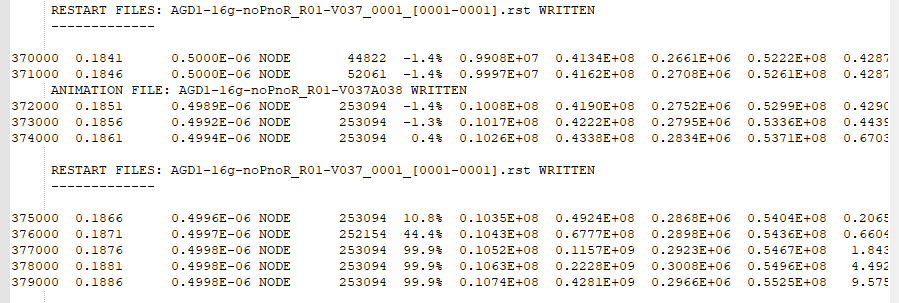
my percentage of error went up so high suddenly, but the simulation completed.
Thanks.
Regards,
Kin Poh
Hi Kin Poh,
The energy error percentage is the parameter that checks the energy conservation during each numerical cycle and it is computed by RADIOSS as a percentage. An increasing Energy Error that reaches ±99% can indicate the simulation has diverged. There are times when a large Energy Error at the end of a simulation can be caused by only one part diverging, but the rest of the model is giving correct results. You can check those nodes, its connected components and review whether any weird behavior is there at the end of the simulation.
Hi George,
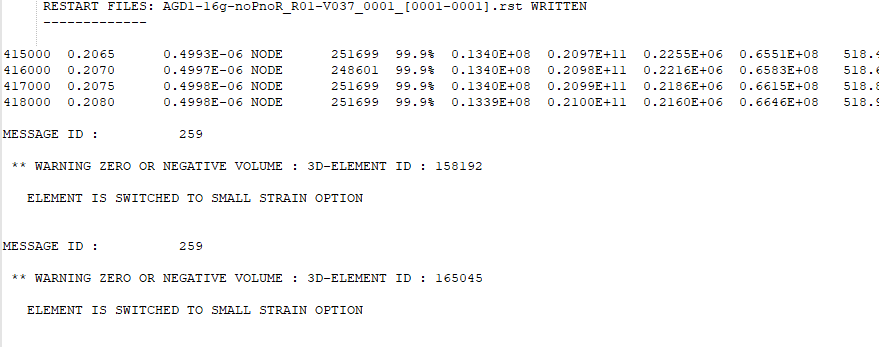
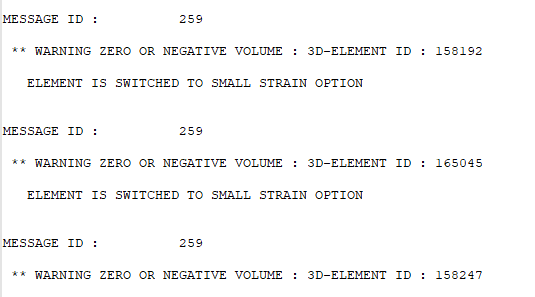
I had troubleshoot it, I think problem is negative volume on it, any idea how to solve this?
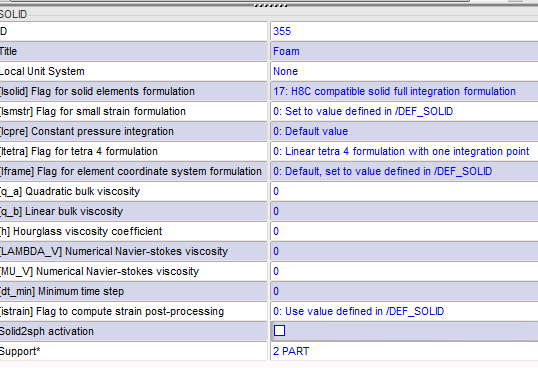
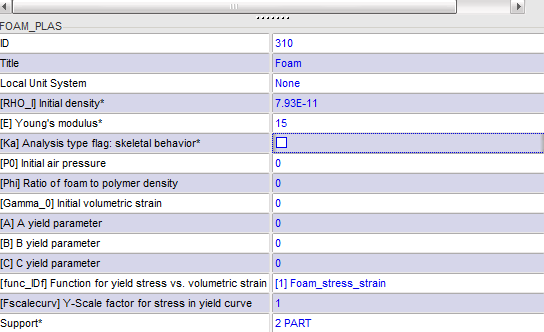
below is the node and the cushion (Solid) property and material
For the solid property can you try running with Isolid=24.
Hi george,
Result still the same.
Any other way?
This is not an issue. High deformations happening for some elements in the model and those elements are switched to small strain option. Due to high deformations their characteristic length goes to 0 which results in negative volume. And for large strain formulation the time step of an element also drops badly when the element is compressed. In such cases the solver automatically switches it to small strain. And I think because of that you are getting high energy in the last few cycles, and it seems okay, you can ignore.
Ismstr = 11 has been developed for Law 70 (foam) and you can try with it. Generally more stable results can be obtained when Ismstr =1, so that from time=0 the elements will be switched to small strain.
Join us for a community conversation on how High-Performance Computing (HPC) and Simcenter PSIM work together to meet the increasing demands of modern power electronics simulation. During this one-hour technical session, you'll discover how leveraging HPC can speed up simulations, improve scalability, and empower engineers…
Join us for a community conversation on accelerating your motor simulation workflow with Simcenter Simlab. In this beginner-friendly session, we'll introduce the platform's automated model-building capabilities and show how easy it is to set up your first electric motor analysis. You'll see the basic steps of geometry…
Join us for a Community Conversation where we'll discuss practical approaches to analyzing complex electromagnetic models using hybrid solver techniques. This session will provide a general overview of how different computational methods can be combined within a single simulation to address models containing varied…