The Siemens Community Catalyst program was co-created with our community to acknowledge technology leaders who consistently contribute to the Siemens Community. Nominations are accepted on a rolling basis.
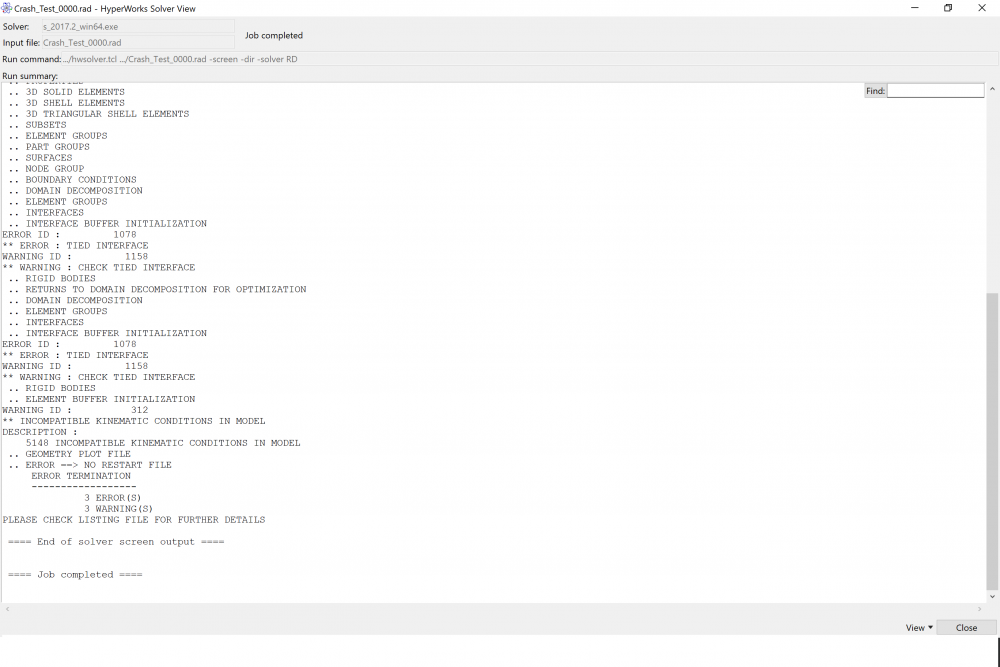
Hello there, I'm trying to run a simulation with RADIOSS 2017, but I keep getting the errors shown in the screenshot attached below. Can anyone help me? I've also attached the .rad file
<?xml version="1.0" encoding="UTF-8"?>
Unable to find an attachment - read this blog
Hi @MatBannwa,
The problem was with the definition of master surface on tied interface: it was referring to the component which also had slave nodes. Basically, it was defined as self-impacting contact interface. A tied interface (TYPE2) can be used to connect a fine mesh of Lagrangian elements to a coarse mesh or two different kinds of meshes (for example, spring to shell contacts). So you need to pick another component as a master surface- I defined contact surface on the bottom of honeycomb. There was no search distance (dsearch) and Ignore should be set to 1 on the tied interface card.
There was also error with 'EN AW 7075' material definition: it did not have function fct_ID referred. So I created some fictional function, just to be able to run the model.
Join us for a community conversation on how High-Performance Computing (HPC) and Simcenter PSIM work together to meet the increasing demands of modern power electronics simulation. During this one-hour technical session, you'll discover how leveraging HPC can speed up simulations, improve scalability, and empower engineers…
Join us for a community conversation on accelerating your motor simulation workflow with Simcenter Simlab. In this beginner-friendly session, we'll introduce the platform's automated model-building capabilities and show how easy it is to set up your first electric motor analysis. You'll see the basic steps of geometry…
Join us for a Community Conversation where we'll discuss practical approaches to analyzing complex electromagnetic models using hybrid solver techniques. This session will provide a general overview of how different computational methods can be combined within a single simulation to address models containing varied…