The Siemens Community Catalyst program was co-created with our community to acknowledge technology leaders who consistently contribute to the Siemens Community. Nominations are accepted on a rolling basis.
Hello Everyone,
I would like to know how the value of stiffness for interface T11 is calculated. Also, what is the aim and the difference in simulation's results between 'no node deletion' and 'when an element is deleted' ?
Thank you
Hi Elamiae,
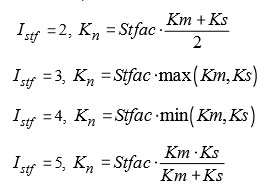
Type 11 interfaces are used to simulate impact between lines for 1D mesh, or edges in shell and solid meshes. When two surfaces contact, a stiffness is introduced to reduce the penetration's nodes of the other surface into the surface. The nature of the stiffness depends on the type of interface and the elements involved. The introduction of this stiffness may have consequences on the time step, depending on the interface type used.
Istf is the stiffness definition flag. Stiffness computed from both master segment stiffness Km and slave segment stiffness Ks is as follows:
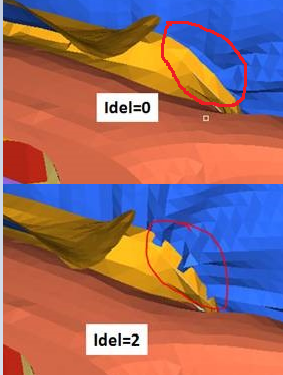
Idel is the node and segment deletion flag. During contacts, when elements are deleted, using this option the segment can be removed from the interface. Using 1 option, when all the elements associated to one segment (master/slave) are deleted, the segment is deleted from interface. Where as for 2, the segment will be deleted if any one element is deleted from the corresponding segment. Default option will be no deletion of segments.
Please see the attached snapshot for a contact where Idel=2 and Idel=0 (no deletion) is used.
Thanks George.
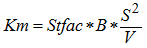
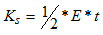
I'm wondering too, how can we calculate the value of Ks and Km? I mean mathematically ?
and .where S is the segment area; V is the volume of the solid, and B is the Bulk Modulus.
I recommend you to check the RADIOSS reference guide where all the parameters considered and calculations are described.
Join us for a community conversation on how High-Performance Computing (HPC) and Simcenter PSIM work together to meet the increasing demands of modern power electronics simulation. During this one-hour technical session, you'll discover how leveraging HPC can speed up simulations, improve scalability, and empower engineers…
Join us for a community conversation on accelerating your motor simulation workflow with Simcenter Simlab. In this beginner-friendly session, we'll introduce the platform's automated model-building capabilities and show how easy it is to set up your first electric motor analysis. You'll see the basic steps of geometry…
Join us for a Community Conversation where we'll discuss practical approaches to analyzing complex electromagnetic models using hybrid solver techniques. This session will provide a general overview of how different computational methods can be combined within a single simulation to address models containing varied…