The Siemens Community Catalyst program was co-created with our community to acknowledge technology leaders who consistently contribute to the Siemens Community. Nominations are accepted on a rolling basis.
I am doing a tensile test analysis; however my analyses take too long on my computer. What should I change at engine file in order to accerelate my analyses.
<?xml version="1.0" encoding="UTF-8"?>
Many factor to consider in your case :
Many factor to consider in your case : Size of your simulation (number of nodes, elements, BC, Loads,....) Capacity of your hardware (CPU, memory,....) Convergence of analysis
I simplied my model as much as possible. I want to reduce iteration number of the analysis
Ismail,
Can you reduce the run time if possible?
Ismail, Can you reduce the run time if possible?
Thank you for your help,
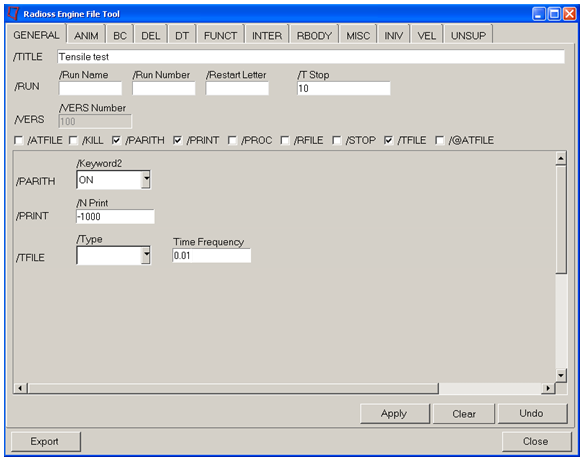
How can I reduce it? Should I reduce (/RUN /TSTOP:10) to a smaller time ? What happen if I increase /TFILE time frequency higher than 0.01?
Yes, reduce the /RUN/TSTOP.
reducing TFILE frequency increases the updates the time history file (T01) within less time intervals. So it will not reduce your total analysis time.,
Yes, reduce the /RUN/TSTOP. reducing TFILE frequency increases the updates the time history file (T01) within less time intervals. So it will not reduce your total analysis time.,
If I increase TFile frequency, what happens to analysis time. In addition; my default value for ANIM/DT Tfreq is 0.5. Should I change it in order to reduce analysis time
Thank you four your help
Increasing TFILE fequency will update the T01 more frequently.
It may not help you to reduce the simulation time.
Also, what is the unit system used for TIME in your model and what are you simulating exactly?
You may reduce the RUN TIME to reduce the simulation time.
Increasing TFILE fequency will update the T01 more frequently. It may not help you to reduce the simulation time. Also, what is the unit system used for TIME in your model and what are you simulating exactly? You may reduce the RUN TIME to reduce the simulation time.
Thank you;
I am doing a tensile test to a new composite material I am working on. Its size is not equal to the part at the tensile test tutorial; that's why analysis takes longer. I am using seconds.
In addition,
I have 8 gb ram available but, analysis only uses 3 gb ram. 4 gb ram remains unused. How can I assign more ram to analysis?
Thank you in advance;
Hi,
Explicit analysis is not Ram intensive.But to reduce your solution time you can add multiple cpu.
For Radioss:
Memory is allocated automatically by RADIOSS Starter. The /MEMORY card is skipped, as the memory is automatically adjusted.
At the bottom of the output file, one can check the memory used for the Starter and needed for the Engine on one processor. It is given in kilowords and to get the real memory one has to perform the following operation:
Memory (bytes) = 8*number of real words + 4*number of integer words
As a general rule, 100MB are needed for 100,000 elements.
Hence it automatically calculates the RAM usage.
Hope it helps..
Regards
Rahul R
Join us for a community conversation on how High-Performance Computing (HPC) and Simcenter PSIM work together to meet the increasing demands of modern power electronics simulation. During this one-hour technical session, you'll discover how leveraging HPC can speed up simulations, improve scalability, and empower engineers…
Join us for a community conversation on accelerating your motor simulation workflow with Simcenter Simlab. In this beginner-friendly session, we'll introduce the platform's automated model-building capabilities and show how easy it is to set up your first electric motor analysis. You'll see the basic steps of geometry…
Join us for a Community Conversation where we'll discuss practical approaches to analyzing complex electromagnetic models using hybrid solver techniques. This session will provide a general overview of how different computational methods can be combined within a single simulation to address models containing varied…