The Siemens Community Catalyst program was co-created with our community to acknowledge technology leaders who consistently contribute to the Siemens Community. Nominations are accepted on a rolling basis.
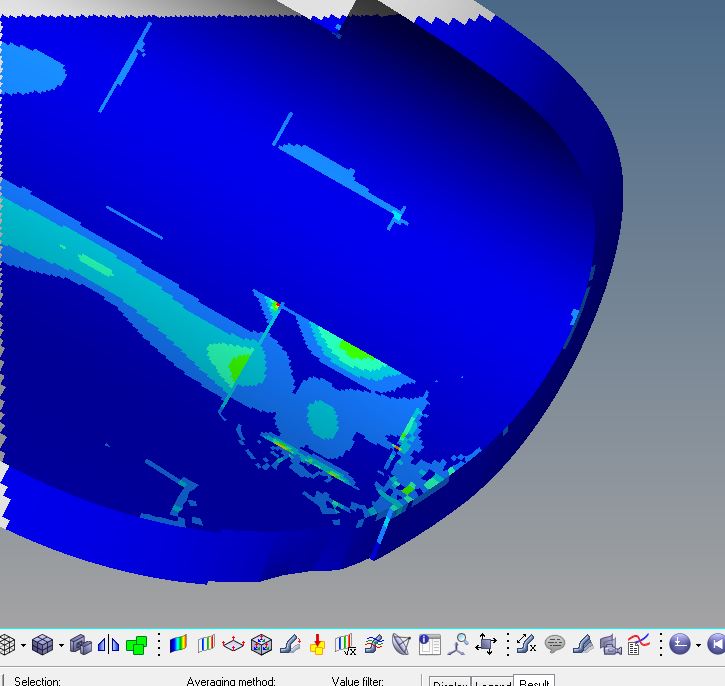
How can I solve this issue. I am using two different mesh densities and connectivity is fine but the result is showing like this.
I have checked for edges and no problem was found.
<?xml version="1.0" encoding="UTF-8"?>
Is this displacement or stress plot?
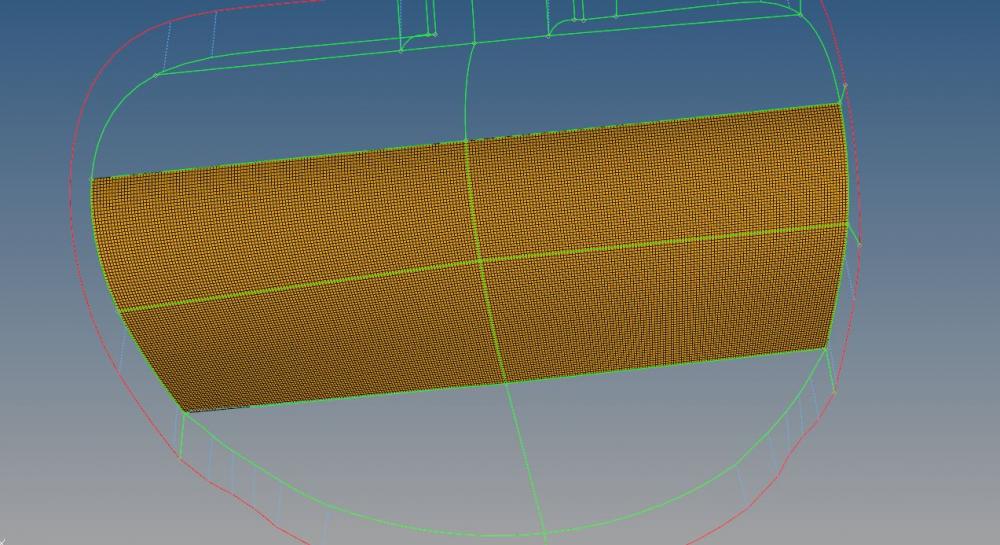
Show us your mesh, share us your model to better understant your issue?
It is a stress plot. Attached is a similar model.
Unable to find an attachment - read this blog
Hi Mithun,
Can you make sure there is no sudden transition at the zone where there is stress deviation and check if this helps?
Hi Prakash,
Already tried meshing 5 or 6 times none of it helped.
If possible check this result in Hyperworks desktop 2017.2 version.If possible share h3d file to check same at our end on latest HW patch.
The actual model is really huge with lot of adhesive joints. In the newer version the adhesive joints are defined differently and hence cannot be translated to the new version. I would really appreciate it if you could help me solve this problem.
Does edges 'Green' has influence on the load path? also is there any video available on how to make a proper mapped mesh with refinements? If possible, could you please illustrate this on a curved surface perhaps?
Make sure you show stress of each layer?
Green edges of geometry has nothing to do with load path but it helps to have connectivity of mesh at the edge.I feel this is completely because of mesh transition with too many trias at that location.you can easily create mapped mesh with secondary Automesh panel & ruled command.PFA screenshot & relevant steps to achieve same output.
Hi,
Thanks for the help guys. it was actually because I forgot to define the material direction after I refined the mesh.
Join us for a community conversation on how High-Performance Computing (HPC) and Simcenter PSIM work together to meet the increasing demands of modern power electronics simulation. During this one-hour technical session, you'll discover how leveraging HPC can speed up simulations, improve scalability, and empower engineers…
Join us for a community conversation on accelerating your motor simulation workflow with Simcenter Simlab. In this beginner-friendly session, we'll introduce the platform's automated model-building capabilities and show how easy it is to set up your first electric motor analysis. You'll see the basic steps of geometry…
Join us for a Community Conversation where we'll discuss practical approaches to analyzing complex electromagnetic models using hybrid solver techniques. This session will provide a general overview of how different computational methods can be combined within a single simulation to address models containing varied…