The Siemens Community Catalyst program was co-created with our community to acknowledge technology leaders who consistently contribute to the Siemens Community. Nominations are accepted on a rolling basis.
i am carrying out impact analysis using 2D elements (Shell)
I am getting error as 'energy limit reached' 'Run killed'
How this can be solved???
Getting energy error as -99.9% right from impact started
Hi,
Please provide more info on model with screenshots , model file etc.
Objective of the simulation?
Any issues with interfaces observed?
Hi Naveen,
For the negative energy error, it means that some energy has been dissipated.
The possible causes for high negative energy error can be:
•Material badly defined
•Large deformation
•Contact interface not correctly defined
Please check the interface for high interface penetrations/distortions in the structure.
Please share the starter out and engine out files.
Dear Mr.Gopal Rathore/Mr.Johnson,
Thanks for the reply..
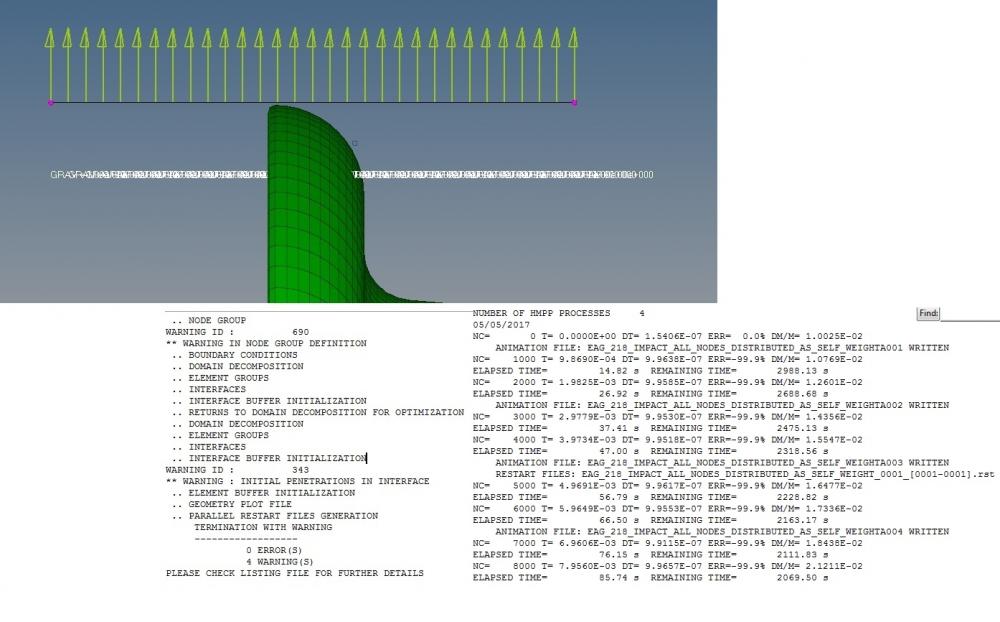
Herewith I attached screenshot of the .hm file and warnings when solving.
Load defined as force for each nodes.(Gravity load)
Distance between impact surface is 0.3 mm(-ve Z direction) and run time of 0.2 ms
<?xml version="1.0" encoding="UTF-8"?>
Please clear the penetrations in the interface and try running the analysis.
Please share the complete engine out (_0001.out) file.
Dear Mr.Johnson,
Attached (_0001.out) file
Unable to find an attachment - read this blog
Hi Naveen, Please check the interface id 1 defined in the model.
Please share the model file through the secure dropbox so that we can review the model.
Join us for a community conversation on how High-Performance Computing (HPC) and Simcenter PSIM work together to meet the increasing demands of modern power electronics simulation. During this one-hour technical session, you'll discover how leveraging HPC can speed up simulations, improve scalability, and empower engineers…
Join us for a community conversation on accelerating your motor simulation workflow with Simcenter Simlab. In this beginner-friendly session, we'll introduce the platform's automated model-building capabilities and show how easy it is to set up your first electric motor analysis. You'll see the basic steps of geometry…
Join us for a Community Conversation where we'll discuss practical approaches to analyzing complex electromagnetic models using hybrid solver techniques. This session will provide a general overview of how different computational methods can be combined within a single simulation to address models containing varied…