The Siemens Community Catalyst program was co-created with our community to acknowledge technology leaders who consistently contribute to the Siemens Community. Nominations are accepted on a rolling basis.
How to find it and deal with it ?
Hi,
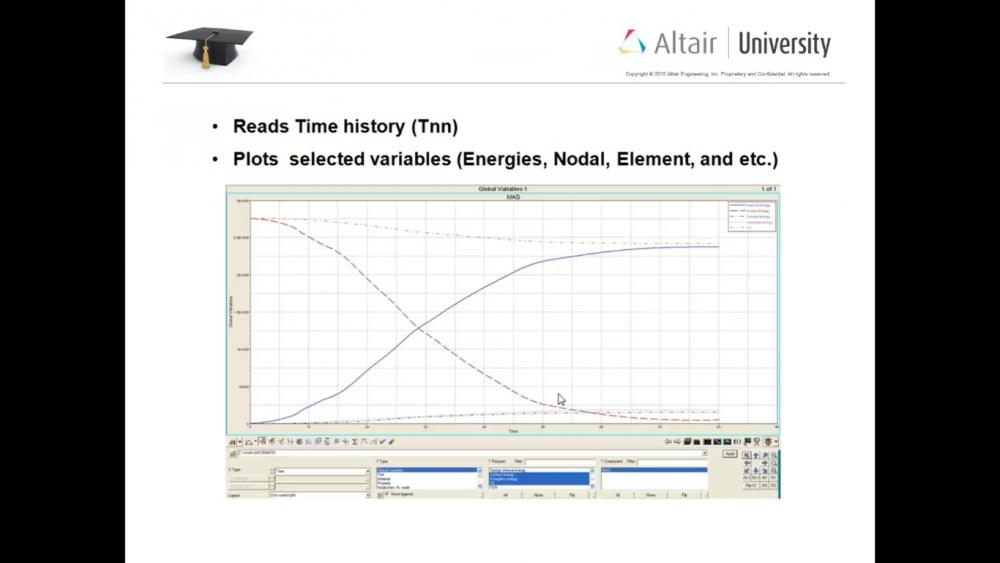
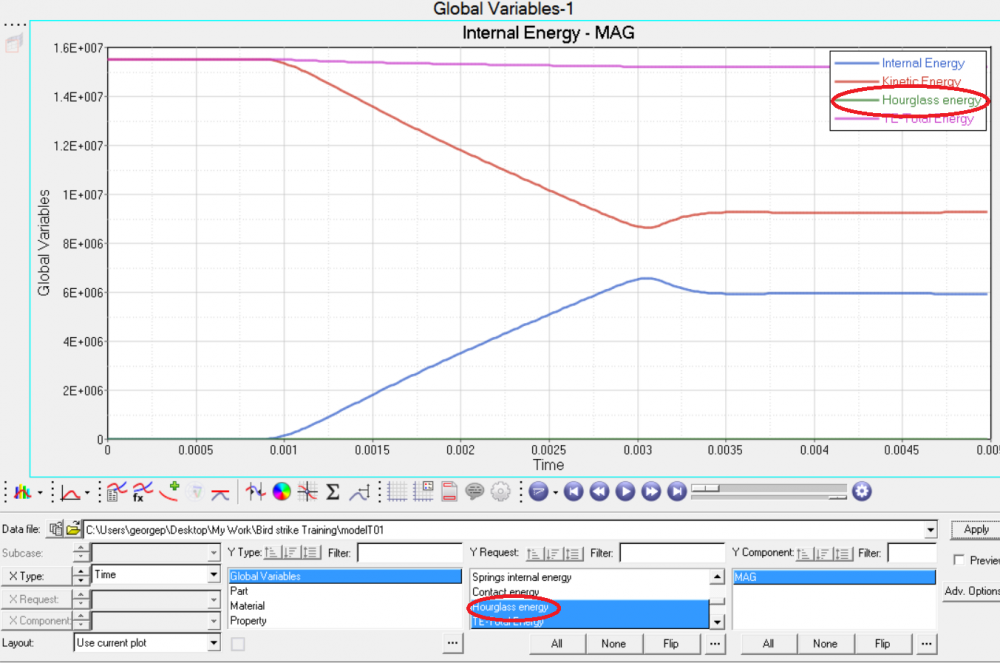
You can check the hourglass energy in the time history (T01) file. If the user create an output block for each part then it is possible to find which part is contributing for hourglass energy.Also, you can check for hourglass energy with /ANIM/ELEM/HOURG keyword in engine file.
As explained in the above post, hourglass modes are present only in under-integrated elements. For shell elements, keep N=5 and for solids use Isolid=14,which is fully integrated element.
ok so we have to get this plot but how?
<?xml version="1.0" encoding="UTF-8"?>
For global energy plot you will get hourglass energy in Y request and the same can be plotted in HyperGraph.
You can also go through this tutorial http://www.altairuniversity.com/wp-content/uploads/2016/11/Crash_Box_1.pdf where these options are shown.
Hi, For global energy plot you will get hourglass energy in Y request and the same can be plotted in HyperGraph. You can also go through this tutorial http://www.altairuniversity.com/wp-content/uploads/2016/11/Crash_Box_1.pdf where these options are shown. <?xml version="1.0" encoding="UTF-8"?>
Hi George.
Where can I find the documents like yours? I searched on the HW help but I did not find anything.
Hi Pohan,
The image above attached is from a model file.
But you can get enough data on these technical topics on our RADIOSS ebook, Crash Analysis With RADIOSS – A Study Guide . Please download the same and refer.
Hi George,
How to create an output block for each part to find which part is contributing for hourglass energy?
Thanks.
Regards,
Kin Poh
Hi Kin Poh,
From Analysis page, create output block for each part. And finally after the run plot the hourglass energy in HyperGraph using the T01 file generated.
Please go through this video series below which is a webinar on RADIOSS and Chapter 6 covers creating output block in RADIOSS.
https://www.youtube.com/watch?v=1BnhOzRVkEQ&index=6&t=3s&list=PLQ7KUGFuVz4u5y3SvIEIU07427-gATaG6
If you still have doubts please let us know so that we can create a short video on the same.
Join us for a community conversation on how High-Performance Computing (HPC) and Simcenter PSIM work together to meet the increasing demands of modern power electronics simulation. During this one-hour technical session, you'll discover how leveraging HPC can speed up simulations, improve scalability, and empower engineers…
Join us for a community conversation on accelerating your motor simulation workflow with Simcenter Simlab. In this beginner-friendly session, we'll introduce the platform's automated model-building capabilities and show how easy it is to set up your first electric motor analysis. You'll see the basic steps of geometry…
Join us for a Community Conversation where we'll discuss practical approaches to analyzing complex electromagnetic models using hybrid solver techniques. This session will provide a general overview of how different computational methods can be combined within a single simulation to address models containing varied…