The Siemens Community Catalyst program was co-created with our community to acknowledge technology leaders who consistently contribute to the Siemens Community. Nominations are accepted on a rolling basis.
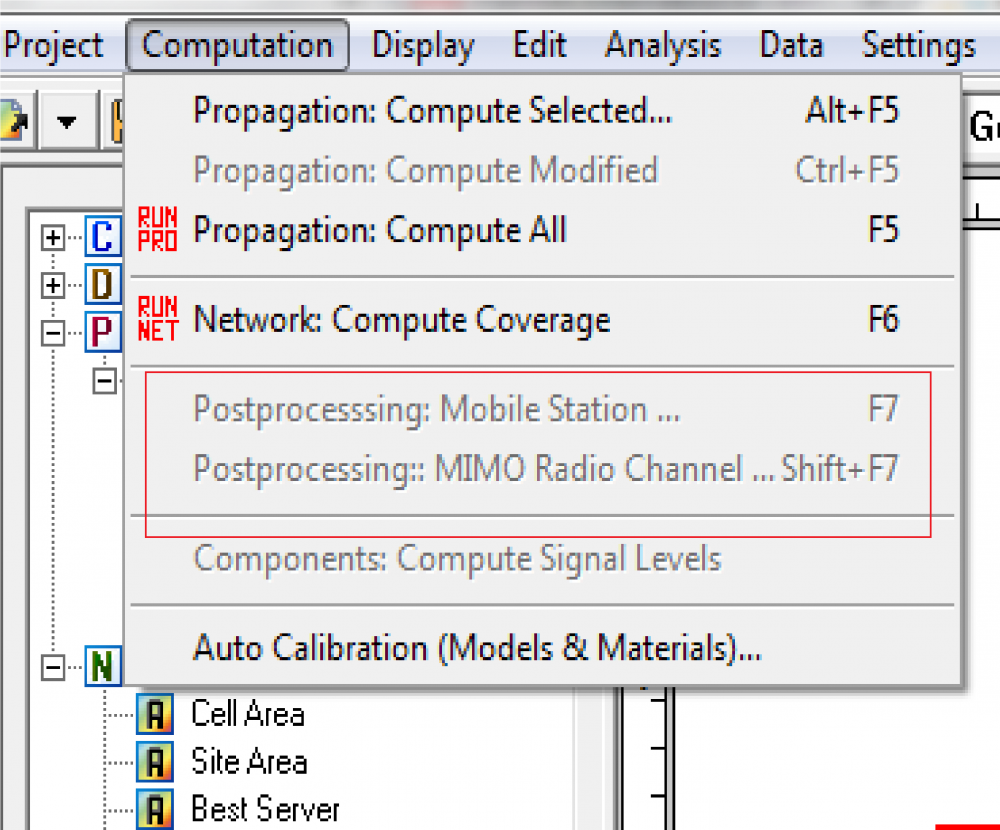
I need an explanation on what the Postprocessing Mobile Station option under the Computation tab does. Thanks
Not sure which menu you are referring to when you mention Computation tab and Postprocessing Mobile Station. There are a few that come close, but I don't see the one you mention. The ones I see are:
1. There is a Computation tab under Project / Edit Project Parameter, but this tab doesn't have the postprocessing option.
2. There is a Propagation tab under Project/ Edit Project Parameter. It has an option Postprocessing --> Consideration of MS Antenna Properties
3. There is a Computation menu; it has an option Propagation Post Processing.
I suspect you mean the second one. There, you can define a receiver antenna pattern, to determine, after a propagation simulation of the transmitter, how much power that receiver antenna would capture, based on its antenna pattern and orientation.
I apologize for the confusion. What I meant is the Post processing mobile station option under the computation menu
<?xml version="1.0" encoding="UTF-8"?>
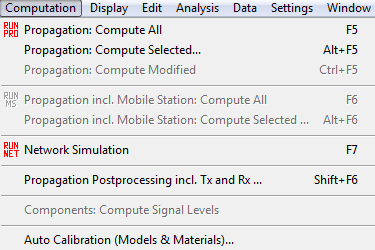
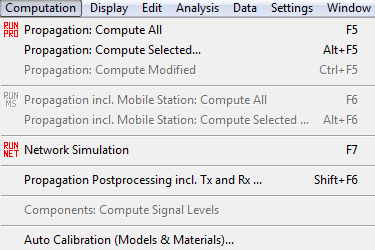
You are probably using an older version of WinProp. In version 2018, the menu looks like this:
I guess that 'PostProcessing: Mobile Station' in your version does the same thing as 'Propagation incl. Mobile Station' in my version. If so, then it is what I mentioned earlier: There, you can define a receiver antenna pattern, to determine, after a propagation simulation of the transmitter, how much power that receiver antenna would capture, based on the receiver's antenna pattern and orientation.
The other one, PostProcessing: MIMO, enables you to go a step further and include the effects of having a small MIMO array. The workflow for MIMO has changed significantly in recent versions, and I have no experience with the way it was before the change.
I hope this helps a bit.
Join us for a community conversation on how High-Performance Computing (HPC) and Simcenter PSIM work together to meet the increasing demands of modern power electronics simulation. During this one-hour technical session, you'll discover how leveraging HPC can speed up simulations, improve scalability, and empower engineers…
Join us for a community conversation on accelerating your motor simulation workflow with Simcenter Simlab. In this beginner-friendly session, we'll introduce the platform's automated model-building capabilities and show how easy it is to set up your first electric motor analysis. You'll see the basic steps of geometry…
Join us for a Community Conversation where we'll discuss practical approaches to analyzing complex electromagnetic models using hybrid solver techniques. This session will provide a general overview of how different computational methods can be combined within a single simulation to address models containing varied…