The Siemens Community Catalyst program was co-created with our community to acknowledge technology leaders who consistently contribute to the Siemens Community. Nominations are accepted on a rolling basis.
Hi,
I read in the forum I can define a toruqe in Radioss with the BC-manager. Concentrated load -> and direction in XX, YY, or ZZ. However, I can't define a rotation point. How to do that?
Thanks, J
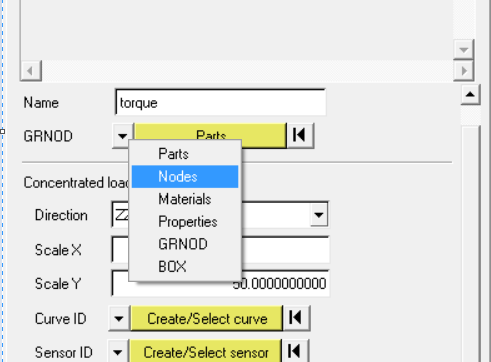
From the BCs manager for CLOAD select node option and select the node where the load is to be applied.
<?xml version="1.0" encoding="UTF-8"?>
This is clear. But this node defines where the force is applied. But I want to define a point where my force rotates around. It should be a moment/torque.
thanks!
You need to first make a skew at the point about which torque is being applied and then use XX,YY,ZZ in the load components based on skew axis direction and assign the magnitude.
Coool! Thanks for the response. That worked well!
Hi, You need to first make a skew at the point about which torque is being applied and then use XX,YY,ZZ in the load components based on skew axis direction and assign the magnitude.
I have two questions:
1. Can we create a skew coordinate system at somewhere which has some distance away from the torque-applying nodes (They are included in a GRNOD set) and choose XX of this skew as the Direction in/CLOAD card? What is really happening if a torque is defined like this?
2. For instance, I have 100 nodes that need to take a total of 200 N*mm torque. But I don't want to use RBE2 or RBODY to create this torque because rigid element will make all its connected nodes become a rigid body causing unwanted stiffing effects to a deformable part. How to maintain the original deformablity of a part but a torque can be defined on it?
Thank you.
Hi @hyperlove,
1. Skew in CLOAD definition is used to define a different coordinate system than the global system. Therefore the orientation (direction) of the skew axis is important, not its relative position.
2. RBE3 elements are used to distribute loads without inducing unwanted stiffness. It is not an element to be used to model a connection, but rather an element to induce motion in a node as a function of the weighted average of other nodes.
Join us for a community conversation on how High-Performance Computing (HPC) and Simcenter PSIM work together to meet the increasing demands of modern power electronics simulation. During this one-hour technical session, you'll discover how leveraging HPC can speed up simulations, improve scalability, and empower engineers…
Join us for a community conversation on accelerating your motor simulation workflow with Simcenter Simlab. In this beginner-friendly session, we'll introduce the platform's automated model-building capabilities and show how easy it is to set up your first electric motor analysis. You'll see the basic steps of geometry…
Join us for a Community Conversation where we'll discuss practical approaches to analyzing complex electromagnetic models using hybrid solver techniques. This session will provide a general overview of how different computational methods can be combined within a single simulation to address models containing varied…