The Siemens Community Catalyst program was co-created with our community to acknowledge technology leaders who consistently contribute to the Siemens Community. Nominations are accepted on a rolling basis.
Could someone tell me the physical meaning of the Explicit calculation error check? I know the meaning of each term. Internal Energy and External work. But why is it important in an explicit calculation to make sure it stays below 5%?
Hi,
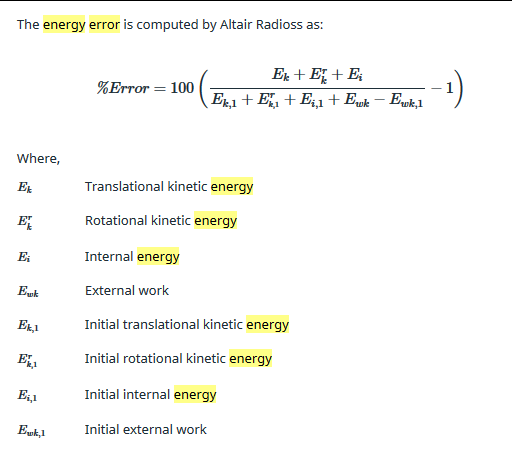
It can be clearly seen from the formula, The error should be negative. Ideally, the error should be at most -15% and better to have -5%. The closer to 0% error the better.Any positive energy error means energy has been created which indicates a model issue. An error of 1 or 2% will be acceptable.
Hi,
The energy error in Radioss is calculated as follows. Note there is no contact energy or hourglass energy terms included in this formula. If contact energy or hourglass energy become large usually that energy ends up increasing the internal or kinetic energy in the model and this causes a larger % energy error. The contact energy or hourglass energy are numerical (not part of the physical problem) and thus for a good simulation they should remain small.
Typically if you have a large energy error you should try to understand why by plotting the energies in the model.
In simulations with no or small initial energy, a small numerical difference in energy causes a large percent error which can be ignored. After additional loads are applied the energy error will usually decrease.
In models where contact friction causes a large amount of contact energy, the energy error can be higher.
Join us for a community conversation on how High-Performance Computing (HPC) and Simcenter PSIM work together to meet the increasing demands of modern power electronics simulation. During this one-hour technical session, you'll discover how leveraging HPC can speed up simulations, improve scalability, and empower engineers…
Join us for a community conversation on accelerating your motor simulation workflow with Simcenter Simlab. In this beginner-friendly session, we'll introduce the platform's automated model-building capabilities and show how easy it is to set up your first electric motor analysis. You'll see the basic steps of geometry…
Join us for a Community Conversation where we'll discuss practical approaches to analyzing complex electromagnetic models using hybrid solver techniques. This session will provide a general overview of how different computational methods can be combined within a single simulation to address models containing varied…
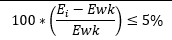 I know the meaning of each term. Internal Energy and External work. But why is it important in an explicit calculation to make sure it stays below 5%?