The Siemens Community Catalyst program was co-created with our community to acknowledge technology leaders who consistently contribute to the Siemens Community. Nominations are accepted on a rolling basis.
Hi,
I have a question regarding PSIM Signal Analyzer. Does it give the measurements in Quasi peak or average? If not, what would be way to convert the peak measurement into QP/average using PSIM.
Any help/comment will be appreciated.
@NikosDimitrakopoulos any insight on this will be helpful
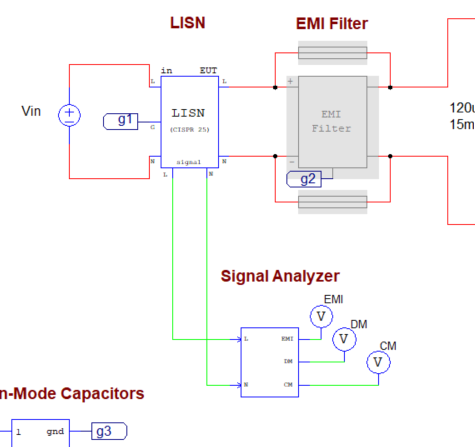
Dear @ashikamineee08, Thanks for reaching out! I believe you are referring the Signal Analyzer block for Conducted EMI measurements:
The outputs of this block are actually time domain signals:
You have the option from within Simview to directly apply an FFT. However, the FFT is neither a peak nor a quasi‑peak algorithm. It is a signal‑processing method used to transform time‑domain data into the frequency domain. FFT is not the best method to investigate EMI results as it often suffers form spectral leakage. This is why windowed-FFT methods are preferred instead and this where the concept of peak/quasi peak/average detection applies. Unfortunately, PSIM doesn't offer an inherent windowed-FFT algorithm. That said, you can connect PSIM simulations and PSIM results with Python to post process as needed: PSIM & Python Hope this helps! BR Nikos Dimitrakopoulos
Join us for a community conversation on how High-Performance Computing (HPC) and Simcenter PSIM work together to meet the increasing demands of modern power electronics simulation. During this one-hour technical session, you'll discover how leveraging HPC can speed up simulations, improve scalability, and empower engineers…
Join us for a community conversation on accelerating your motor simulation workflow with Simcenter Simlab. In this beginner-friendly session, we'll introduce the platform's automated model-building capabilities and show how easy it is to set up your first electric motor analysis. You'll see the basic steps of geometry…
Join us for a Community Conversation where we'll discuss practical approaches to analyzing complex electromagnetic models using hybrid solver techniques. This session will provide a general overview of how different computational methods can be combined within a single simulation to address models containing varied…