The Siemens Community Catalyst program was co-created with our community to acknowledge technology leaders who consistently contribute to the Siemens Community. Nominations are accepted on a rolling basis.
Hello every one
I use HW 17. With HM I can export my model to Radioss 14 but with HyperCrach I can not. Could you please tell me how to deal with this problem
Thanks
Hi Pohan,
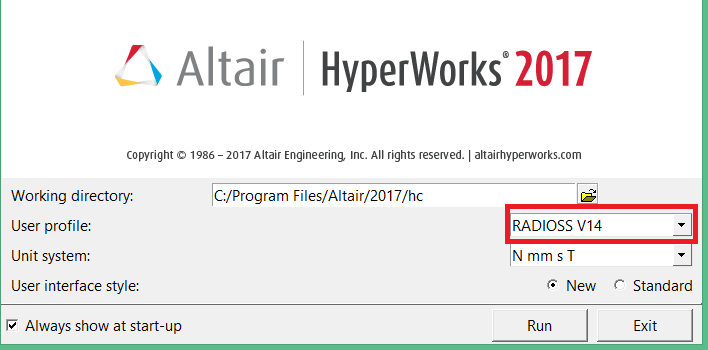
While opening HyperCrash select the user profile RADIOSS V14 and export the file. The file will be exported in 14 version.
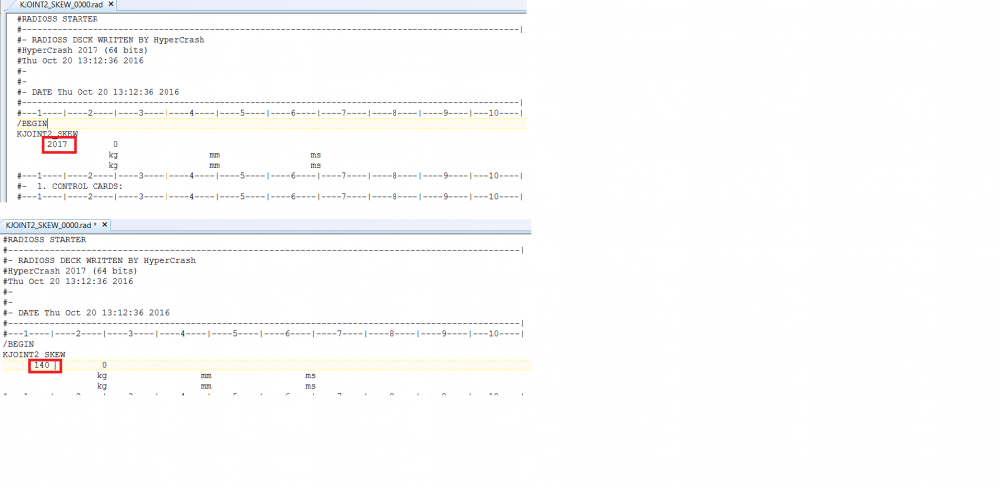
The other option is editing manually. Export the file from HyperCrash 2017 version. Open the *_0000.rad file in Textpad or Notepad and manually change 2017 to 140.
<?xml version="1.0" encoding="UTF-8"?>
Hi George
I did as you said but when I imported the 0000.rad file it said *** Read Error: Cannot read RADIOSS input decks version: 201.7 ***
Which option did you try?. Did you manually edit and imported the file?.
If so, please check whether it is 2017 or 201.7 in the file.
I used both. And in the file it is #HyperCrash 2017.1 (64 bits)
Hi,
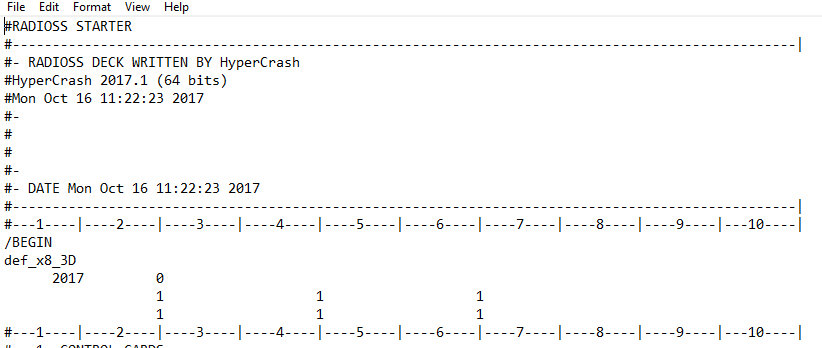
Could you please share the same model file, so that we can review it. Or open the file in Textpad and share a screenshot of the /BEGIN card, where the version and unit system is shown ( a similar image as in the above post).
Hi
This is the picture that you want
This seems fine and it should open in HyperMesh or HyperCrash 2017 version.
Can you please share the file.
I sent to the Secure file dropbox
I'm able to import the same file in HyperCrash 2017 version.
Please make sure that you have selected user profile as RADIOSS V2017 while starting HyperCrash in order to import a 2017 file.
I want to convert this file to Radioss 14 because in my university we use the cluster with HW14
Then the best and easy approach is to edit manually 2017 to 140 in Textpad.
Thanks,
It really helpful and easy./emoticons/default_smile.png' srcset='/emoticons/smile@2x.png 2x' title=':)' width='20' />
Join us for a community conversation on how High-Performance Computing (HPC) and Simcenter PSIM work together to meet the increasing demands of modern power electronics simulation. During this one-hour technical session, you'll discover how leveraging HPC can speed up simulations, improve scalability, and empower engineers…
Join us for a community conversation on accelerating your motor simulation workflow with Simcenter Simlab. In this beginner-friendly session, we'll introduce the platform's automated model-building capabilities and show how easy it is to set up your first electric motor analysis. You'll see the basic steps of geometry…
Join us for a Community Conversation where we'll discuss practical approaches to analyzing complex electromagnetic models using hybrid solver techniques. This session will provide a general overview of how different computational methods can be combined within a single simulation to address models containing varied…