The Siemens Community Catalyst program was co-created with our community to acknowledge technology leaders who consistently contribute to the Siemens Community. Nominations are accepted on a rolling basis.
Hi All,
How to output the results for Effective Mass Participation Factor in modal Analysis ?
Is it sufficient to look for the first 6 to 10 modes or a couple of hundred Hz (say 500 Hz) ?
Use control card PARAM,EFFMAS,YES.
Modal mass results written to .out file.
Hi All, How to output the results for Effective Mass Participation Factor in modal Analysis ? Is it sufficient to look for the first 6 to 10 modes or a couple of hundred Hz (say 500 Hz) ?
Is it sufficient to look for the first 6 to 10 modes or a couple of hundred Hz (say 500 Hz) ?
Hi,
Selection of modes depend on your area of interest in frequency range , based on these you need to observe the mode shapes and also check the mass participation in that particular mode.
Also try to understand based on your operating condition which mode would be more severe i.e the object has the tendency to have during the operating conditions.
Are you working on a fixture design?
Thank you @gopal_rathore,
Not fixture design.
I came across a term Effective Mass Participation Factor online.
Hi @Karthic
Number of modes and EMPF are interdependent.
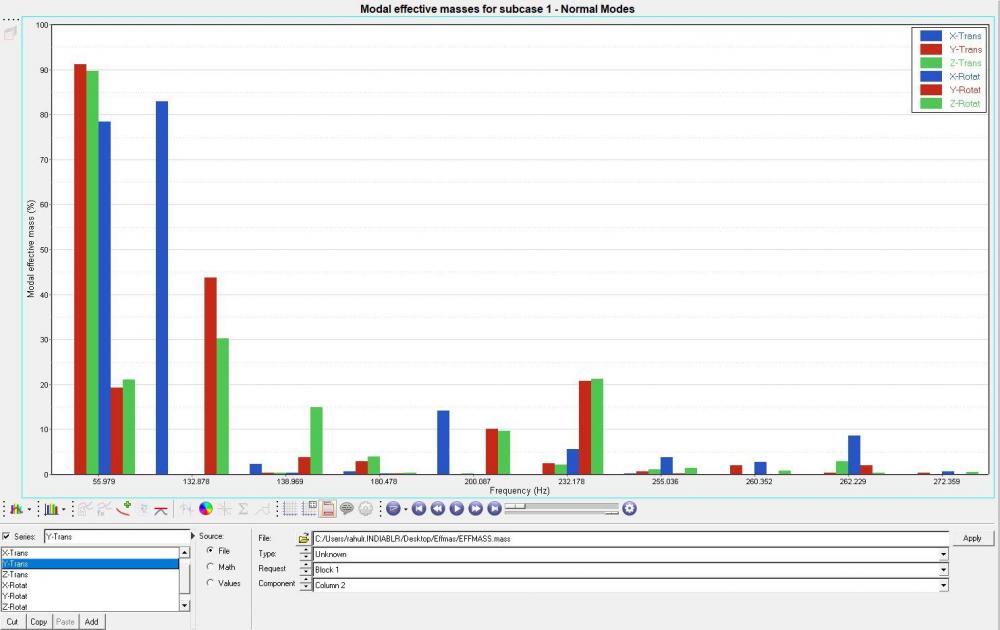
Generally, a mode with higher EMPF is considered significant contributor and a cumulative EMPF more than 80% in any given response direction considered as sufficient.
i am trying calculate the EMPF but its not showing anything in the out file?
help me with this
Thank you
Additionally, you can request under OUTPUT> HGEFFMASS to write out the *.mass,*mass.mvw session files which can be directly loaded in HyperGraph to visualize the bar charts detailing on the effective mass output.
Please also try output results in punch format and open the .pch file. Files attached for your reference.
<?xml version="1.0" encoding="UTF-8"?>
Unable to find an attachment - read this blog
sir modal effective mass and mass effective are same ?
Please refer attached document from help.
Join us for a community conversation on how High-Performance Computing (HPC) and Simcenter PSIM work together to meet the increasing demands of modern power electronics simulation. During this one-hour technical session, you'll discover how leveraging HPC can speed up simulations, improve scalability, and empower engineers…
Join us for a community conversation on accelerating your motor simulation workflow with Simcenter Simlab. In this beginner-friendly session, we'll introduce the platform's automated model-building capabilities and show how easy it is to set up your first electric motor analysis. You'll see the basic steps of geometry…
Join us for a Community Conversation where we'll discuss practical approaches to analyzing complex electromagnetic models using hybrid solver techniques. This session will provide a general overview of how different computational methods can be combined within a single simulation to address models containing varied…