The Siemens Community Catalyst program was co-created with our community to acknowledge technology leaders who consistently contribute to the Siemens Community. Nominations are accepted on a rolling basis.
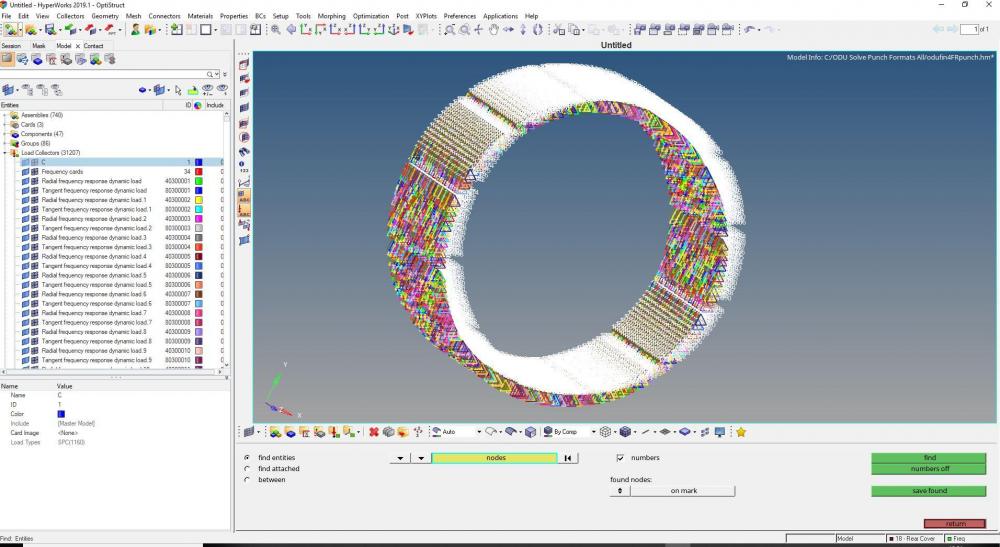
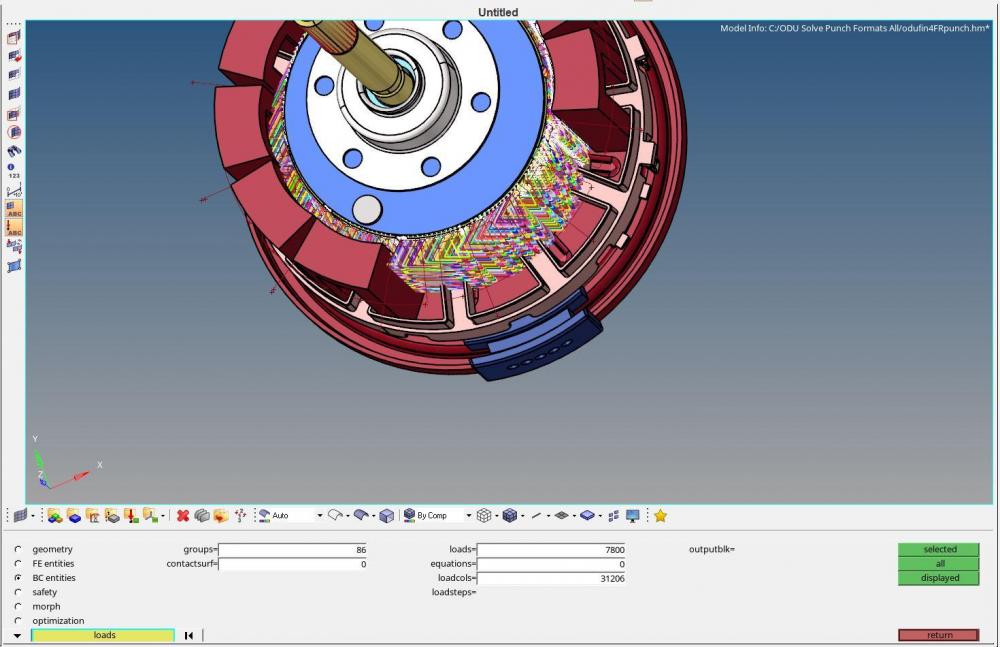
I am solving a frequency response simulation. The loads that are frequency dependent are mapped on to the ID surface, as shown in fig.
How to determine the sum of the displayed loads as shown in figure.?
<?xml version="1.0" encoding="UTF-8"?>
Hi Karth
You can check that using Tool<<Count<<BC Entities<<make sure the loads are selected<<Right click on loads select displayed.
Make Sure that in model browser all the frequency dependent loads are displayed.
Regards
Shrinaath Viswanathan
Hi,
I think I have not made the question clear.
The option you had suggested highlights the total count of loads.
My requirement is to determine the sum of magnitudes of the displayed loads (eg. 1000N or 250 N etc.)
I believe you applied load on the nodes.Is that a static load or Dynamic load?If its is static then just count the no of nodes where you applied load....Ensure that load magnitude is uniform or not..If uniform, then just multiply the load magnitude with no of nodes where you apply static load.
The loads are applied on the nodes through an fem file that was exported from Flux software. The loads are frequency based loads. Each node has several loads associated with it based upon the frequency.
@Rahul R Thank you for the response, I have one more question
What About if I apply an enforced displacement in several nodes and I want to display Force vs Displacement curve, then how can I sum the Force that is creadted in each node ?
Thank you again
Join us for a community conversation on Pulse Width Modulation (PWM), a fundamental technique in electric motor control, and explore how different PWM strategies can yield significantly different results. This webinar provides a comparative analysis of various PWM methods and their effects on motor efficiency, torque…
Join us for a community conversation to discover the Advanced Iterative Solver(AIS) in Simcenter Feko and its application to electrically large and computationally demanding electromagnetic models. The session will provide a general overview of how iterative solution methods can help improve efficiency of large scale…
Join us for a community conversation on how High-Performance Computing (HPC) and Simcenter PSIM work together to meet the increasing demands of modern power electronics simulation. During this one-hour technical session, you'll discover how leveraging HPC can speed up simulations, improve scalability, and empower engineers…