The Siemens Community Catalyst program was co-created with our community to acknowledge technology leaders who consistently contribute to the Siemens Community. Nominations are accepted on a rolling basis.
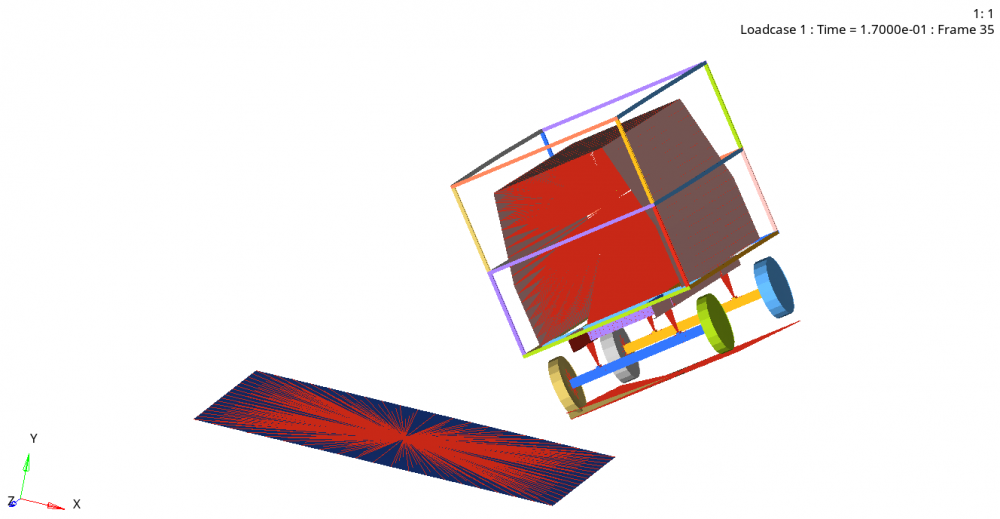
Hello. I'm carrying out roll over analysis on simple bus as shown in attached image. I've assigned imposed velocity along axis and not get rotation on tilt table. Ff you can help me in achieving a tilt please provide some steps to follow.
<?xml version="1.0" encoding="UTF-8"?>
Unable to find an attachment - read this blog
Hi,
here is the Procedure to apply Initial_velocity around an axis
9- Procedure to apply Initial_velocity around an axis - Altair University
Also, make sure to constrain de independent node of a rigid body in all other degrees of freedom.
Share the model if the issue persists.
This is my model. Can you tell me anything wrong with my model
Hi, -you have created rigid with the master node on a structural element- this is not allowed. Make sure you use the 'calculate node' or pick a free node (not connected to other elements) as independent node when creating rigid elements. Set Icog=3 or 4 so the master node will not be moved to CG -check unit consistency: the material properties are in tonne, mm, s so the gravity should be 9810. Also, define appropriate units in the begin card -gravity was acting in the wrong direction, so a negative scale factor was applied to reverse the direction -the boundary condition on the tilted platform constrained 1236 DOF. It should constrain 12345 instead -the contact sets between wheels and tilting platform were swapped -advanced mass scaling AMS is used instead of DT/NODA/CST mass scaling -the run time was extended to allow the bus to hit the ground -the floor is not large enough: rigid wall can be used as ground instead
Oke thank you very much. I will try to follow your steps
I am stuck in rollover simulation this bus, can you help me with this?I am attached error data from Radioss log. Can I email you privately?
ERROR ID : 286 ** ERROR IN INPUT CONSISTENCY DESCRIPTION : 2D SOLIDS (QUAD AND TRIA) ARE NOT COMPATIBLE WITH N2D3D=0
There are QUAD elements, which are not compatible with 3D analysis. Go to 2D> ELEMTYPES> 2D & 3D and make sure types are as shown in the below image. If not change the tria3=SHELL3N and quad4=SHELL4N.
ERROR ID : 126 ** ERROR IN MATERIAL INPUT
The material table is not referenced properly.
Leave your email and I will contact you.
hello this is my email: ewsaputro@student.undip.ac.id
Hi, I applied rigid body between chassis and floor. But there is something wrong between connection. I am attached the result video, can you help me to show the problem.
check the units used for added masses. Their magnitudes are consistent with kg, not with tonnes which are units used for material laws. Therefore the weight of the added masses is 1000x too high.
I am doing a similar kind of rollover analysis, but I couldnt find where I have made a mistake. There are no errors shown in the solver, still I have a problem making the bus frame crash into the platform. Can you help me with the analysis. I have attached the link for the .hm file. Thanks in advance.
https://drive.google.com/file/d/1CKshIkwsQ600ICGHtZjHYKohSIB6WlC5/view?usp=sharing
Join us for a community conversation on how High-Performance Computing (HPC) and Simcenter PSIM work together to meet the increasing demands of modern power electronics simulation. During this one-hour technical session, you'll discover how leveraging HPC can speed up simulations, improve scalability, and empower engineers…
Join us for a community conversation on accelerating your motor simulation workflow with Simcenter Simlab. In this beginner-friendly session, we'll introduce the platform's automated model-building capabilities and show how easy it is to set up your first electric motor analysis. You'll see the basic steps of geometry…
Join us for a Community Conversation where we'll discuss practical approaches to analyzing complex electromagnetic models using hybrid solver techniques. This session will provide a general overview of how different computational methods can be combined within a single simulation to address models containing varied…