The Siemens Community Catalyst program was co-created with our community to acknowledge technology leaders who consistently contribute to the Siemens Community. Nominations are accepted on a rolling basis.
Hi,https://altairuniversity.com/learning-library/v_e_spring-element-type-8/ In the first example of the video on the link above, instructor has two cylinder laid in same axis. Each cylinder has one RBODY with their whole nodes. And RBODY's independent nodes weren't created using calculated nodes. Then, how did he create 'zero-length' spring as he told in the video ??
Hi Omer Faruk GUMUS
And RBODY's independent nodes weren't created using calculated nodes
Yes, it is created using calculate node option only
The zero length spring (type 8) is created by connecting the 2 independent node of the rigids.
Thanks Mr. Pranav. I actually wondered about if a mass and inertia are unnecessary just only when I create the spring by two independent nodes. In the video , the instructor could write '0' for mass and inertia in hypercrash interface. But it is not possible to set 0 value for mass and inertia in hypermesh interface , if you try, you'll get * sign with red color. So, so zero length means that mass and inertia are not taken into consideration ???
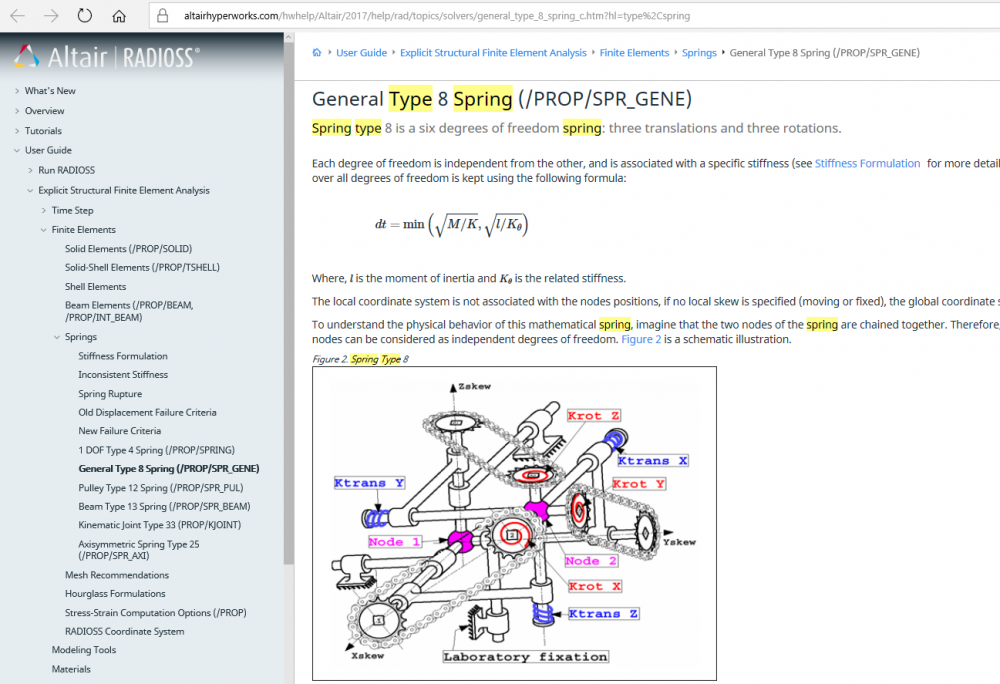
Spring type 8 is a six degrees of freedom spring: three translations and three rotations. It is often used to model a joint connection between two parts.
So, so zero length means that mass and inertia are not taken into consideration ???
You can even assign mass and inertia to a type 8 spring if you want to study the load conditions. It depends on the application whether to use it or not. In this case we are not assigning because we are considering for a joint and the DOFs are of interest.
Please check the Radioss theory manual for more details regarding the type 8 spring
<?xml version="1.0" encoding="UTF-8"?>
Thanks
Join us for a community conversation on how High-Performance Computing (HPC) and Simcenter PSIM work together to meet the increasing demands of modern power electronics simulation. During this one-hour technical session, you'll discover how leveraging HPC can speed up simulations, improve scalability, and empower engineers…
Join us for a community conversation on accelerating your motor simulation workflow with Simcenter Simlab. In this beginner-friendly session, we'll introduce the platform's automated model-building capabilities and show how easy it is to set up your first electric motor analysis. You'll see the basic steps of geometry…
Join us for a Community Conversation where we'll discuss practical approaches to analyzing complex electromagnetic models using hybrid solver techniques. This session will provide a general overview of how different computational methods can be combined within a single simulation to address models containing varied…