The Siemens Community Catalyst program was co-created with our community to acknowledge technology leaders who consistently contribute to the Siemens Community. Nominations are accepted on a rolling basis.
Hi...
Could anybody let me know the list of analysis that can be done for automotive braking system?? and the corresponding inputs requirement to carryout analysis.
Thanks in advance
Nagaraja D
your question is a bit too generic. There's plenty of analysis from simple ones to complex ones.
It would be better if you describe your context.
For NVH, for example, Brake Squeal for noise, FRF and Transient.
https://www.altair.com/search/?q=brake
Hi... Could anybody let me know the list of analysis that can be done for automotive breaking system?? and the corresponding inputs requirement to carryout analysis. Thanks in advance Nagaraja D
Could anybody let me know the list of analysis that can be done for automotive breaking system?? and the corresponding inputs requirement to carryout analysis.
Hi Nagaraja,
I'm working on the modelling of squeal instability for an automotive breaking system. Normally, you have two options to solve the motion equation :
1- Transient Analysis : It's toooo expensive and we don't use it in the industrial context. There is an advanced algorithm to enhance the computational cost. But in general, It remains costly.
2- Complex Eigenvalue Analysis : The widely used method. The main inconvenient of the CEA technique is the fast that it over or under-estimates the physics.
Let me know if you want to go in details and discuss the numerical implementation.
Cheers,
@FaroukM Glad that you are also working on braking system. Is it possible to share your project details/analysis details if thr is no confidentiality issue?
thanks,
thenagu@gmail.com
@FaroukM Glad that you are also working on braking system. Is it possible to share your project details/analysis details if thr is no confidentiality issue? thanks, Nagaraja D thenagu@gmail.com
It's confidential. But we can talk about the classic methods (CEA or DTA).
Can anybody share me the mat9 properties taken for pad material for brake study.
The brake system taken in brsq.fem (optistruct example model) is in z direction. My model is in Y direction. Wat are the changes do I need do to with respect to co-ordinate system (local/global) as well as with constraints..
@FaroukM I guess u worked for braking system project. Pls provide mail id or nay contact details to reach you to discuss in this.. as Altair forum Is not allowing me to msg.
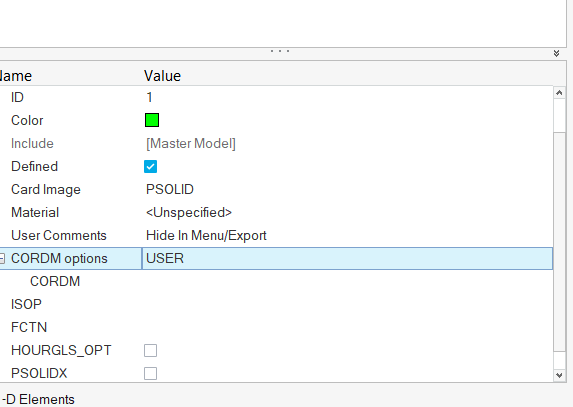
you just need to go under the PSOLID property and adjust the COORM system, to 'USER' and choose a system that corresponds to your orientation.
Wat are the changes do I need do to with respect to co-ordinate system (local/global) as well as with constraints..
I do exactly as @Adriano A. Koga said. Other details is I prefer the MAT9ORT to avoid an unstable compliance matrix. (MAT9ORT = inv(MAT9) ).
Pls provide mail id or nay contact details to reach you to discuss in this
farouk.maaboudallah@usherbrooke.ca
/profile/92911-faroukm/?do=hovercard' data-mentionid='92911' href='<___base_url___>/profile/92911-faroukm/' rel=''>@FaroukM /profile/97129-adriano-a-koga/?do=hovercard' data-mentionid='97129' href='<___base_url___>/profile/97129-adriano-a-koga/' rel=''>@Adriano A. KogaThanks for your quick reply. Aren't we considering the rotor rpm here?? If we can consider where can i input in the deck??
/profile/92911-faroukm/?do=hovercard' data-mentionid='92911' href='<___base_url___>/profile/92911-faroukm/' rel=''>@FaroukM /profile/97129-adriano-a-koga/?do=hovercard' data-mentionid='97129' href='<___base_url___>/profile/97129-adriano-a-koga/' rel=''>@Adriano A. KogaThanks for your quick reply. Aren't we considering the rotor rpm here?? If we can consider where can i input in the deck?? thanks, Nagaraja D
For the rpm, optistruct implementation supports only an angular displacement. You have to create a cylindrical coordinate and then apply a displacement following e_\theta.
We can discuss the results after if you want ...
Join us for a community conversation on how High-Performance Computing (HPC) and Simcenter PSIM work together to meet the increasing demands of modern power electronics simulation. During this one-hour technical session, you'll discover how leveraging HPC can speed up simulations, improve scalability, and empower engineers…
Join us for a community conversation on accelerating your motor simulation workflow with Simcenter Simlab. In this beginner-friendly session, we'll introduce the platform's automated model-building capabilities and show how easy it is to set up your first electric motor analysis. You'll see the basic steps of geometry…
Join us for a Community Conversation where we'll discuss practical approaches to analyzing complex electromagnetic models using hybrid solver techniques. This session will provide a general overview of how different computational methods can be combined within a single simulation to address models containing varied…