The Siemens Community Catalyst program was co-created with our community to acknowledge technology leaders who consistently contribute to the Siemens Community. Nominations are accepted on a rolling basis.
Hello,
I am working on model having rubber seal. I want to find out deformation in seal when force applied on mating part. Which Material Model and analysis Type i should use in order to do analysis in case of rubber
Thanks in advance,
You can refer attached example from OptiStruct online help.
Unable to find an attachment - read this blog
OptiStruct Nonlinear Learning Center
@Rahul R
Thank You sir
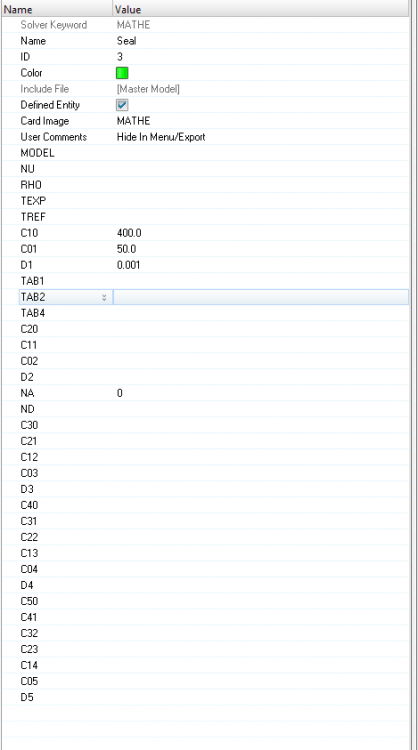
I am Facing This error
'MATHE 3' This line was interpreted as: 330402:MATHE, 3 *** ERROR # 1000 *** in the input data: Incorrect data in field # 3. Expected STRING, found BLANK.
<?xml version="1.0" encoding="UTF-8"?>
Hi Teja,
Can you please share the model file?
I ran the file which you shared without any modifications and I didn't see any error and the solver starts the calculations.
Which version of HW are you using?
I used 2017.2
hi @Prakash Pagadala
I Have ran that model but i found plastic strain result as 0. Please check
Thanks for your reply
hi @Prakash Pagadala I Have ran that model but i found plastic strain result as 0. Please check Thanks for your reply
I Have ran that model but i found plastic strain result as 0. Please check
OK, this is because there is no stress strain data for any mat1/mats1 and MATHE doesn't provide plastic strain as output
Can please share me any case study or Tutorial about sealing. We general use them for many problems.
Thanks for ur support
There is a tutorial on the gasket in OptiStruct, Please check the same.
For rubber seal deformation analysis, selecting the appropriate material model is often more important than simply choosing a nonlinear analysis. Since rubber undergoes large elastic deformations, conventional linear elastic material models generally do not provide accurate results.
The choice of hyperelastic model depends on the amount of deformation and the availability of material test data. Models such as Neo-Hookean may be suitable for relatively small strains, while Mooney-Rivlin or Ogden models are commonly used for engineering rubber components that experience moderate to large deformation. The accuracy of any of these models, however, relies on having experimentally determined material constants obtained from tensile, compression, or biaxial testing.
For seal applications, it is also important to define proper contact interactions between the rubber seal and the mating components. Contact pressure distribution, compression set, and the percentage of seal squeeze can significantly influence the sealing performance. In many practical designs, a compression range of around 15–30% is considered during the initial design stage, depending on the seal geometry and elastomer grade.
If your objective is to evaluate sealing effectiveness rather than just total deformation, it is worth reviewing contact pressure contours in addition to displacement results. A seal that deforms significantly does not necessarily provide effective sealing unless sufficient and uniform contact pressure is maintained throughout the sealing interface.
Has the rubber material been characterized experimentally, or are you currently using standard material constants from the software library? The availability of actual test data will greatly improve the accuracy of the simulation.
Join us for a community conversation on how High-Performance Computing (HPC) and Simcenter PSIM work together to meet the increasing demands of modern power electronics simulation. During this one-hour technical session, you'll discover how leveraging HPC can speed up simulations, improve scalability, and empower engineers…
Join us for a community conversation on accelerating your motor simulation workflow with Simcenter Simlab. In this beginner-friendly session, we'll introduce the platform's automated model-building capabilities and show how easy it is to set up your first electric motor analysis. You'll see the basic steps of geometry…
Join us for a Community Conversation where we'll discuss practical approaches to analyzing complex electromagnetic models using hybrid solver techniques. This session will provide a general overview of how different computational methods can be combined within a single simulation to address models containing varied…