The Siemens Community Catalyst program was co-created with our community to acknowledge technology leaders who consistently contribute to the Siemens Community. Nominations are accepted on a rolling basis.
Hi,
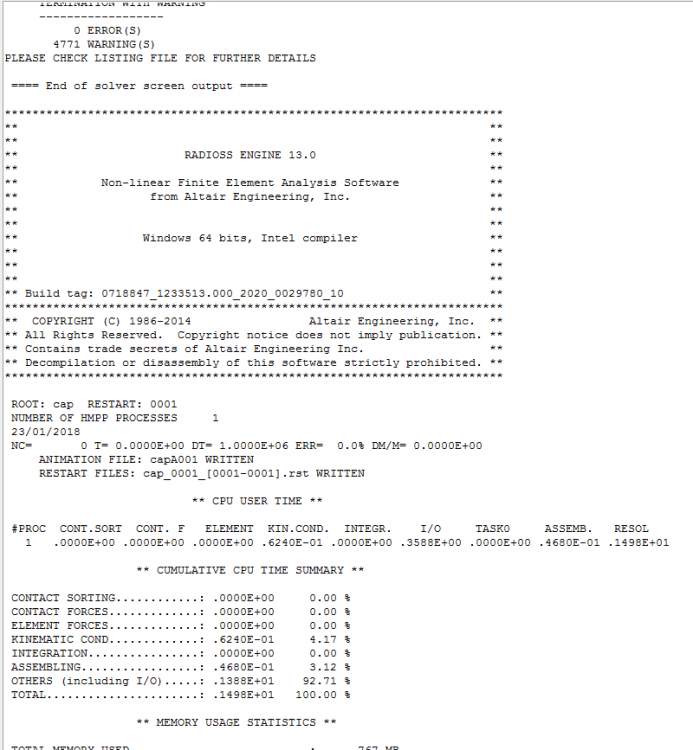
I am trying to run the following deck file. But there is some problem. It shows Zero error still it cant complete run.
<?xml version="1.0" encoding="UTF-8"?>
Unable to find an attachment - read this blog
Hi Harsh
If you could see your DT is very high. What material you are using? Kindly verify your units.
No nodes/node groups are selected for the imposed displacement load collector. Please update the same and also let us know which unit system you are following in this model?
Hi, No nodes/node groups are selected for the imposed displacement load collector. Please update the same and also let us know which unit system you are following in this model?
Hi Harsh If you could see your DT is very high. What material you are using? Kindly verify your units.
Hello ,
Nachiket, I tried with lower time step also. i.e 1e-006 but result is same. I use Mat Law 36, Material is Plastic PolyPropelyne.
George, I will Correct the load collector. Unit System is g, mm, ms.
Hello,
I changed time step, add node set to Boundary condition. Still same result.
The problem is with rigid element. just try to give rigid on outer surface and run the simulation.
Further, I would suggest you to follow tonne,mm,ms system.
I think changing time step wont work here because the system calculated time step is much higher, so solver will try to choose maximum of the system calculated and user fed.
The model is having only rigid body and a rigid body element will have very high time step as there is nothing to solve for it. Thus you are getting high time step and job stops.
As this is an impact problem with part located very close to rigid wall, remove the rbody from it and run.
If it is a free fall impact, make use of initial velocity (calculated at height just above the ground)as boundary condition.
Reviewed your model.
In this model you are trying to impact a rigid to rigid, and there is no physics happening in this simulation. RADIOSS takes the rigid body time step to run the simulation which is very high and the run terminates in one cycle.
Join us for a community conversation on how High-Performance Computing (HPC) and Simcenter PSIM work together to meet the increasing demands of modern power electronics simulation. During this one-hour technical session, you'll discover how leveraging HPC can speed up simulations, improve scalability, and empower engineers…
Join us for a community conversation on accelerating your motor simulation workflow with Simcenter Simlab. In this beginner-friendly session, we'll introduce the platform's automated model-building capabilities and show how easy it is to set up your first electric motor analysis. You'll see the basic steps of geometry…
Join us for a Community Conversation where we'll discuss practical approaches to analyzing complex electromagnetic models using hybrid solver techniques. This session will provide a general overview of how different computational methods can be combined within a single simulation to address models containing varied…