The Siemens Community Catalyst program was co-created with our community to acknowledge technology leaders who consistently contribute to the Siemens Community. Nominations are accepted on a rolling basis.
Dear Sir,
i am working on crash analysis , to study about material behavior , as my solver run properly , no error found . but .h3d file is not generated
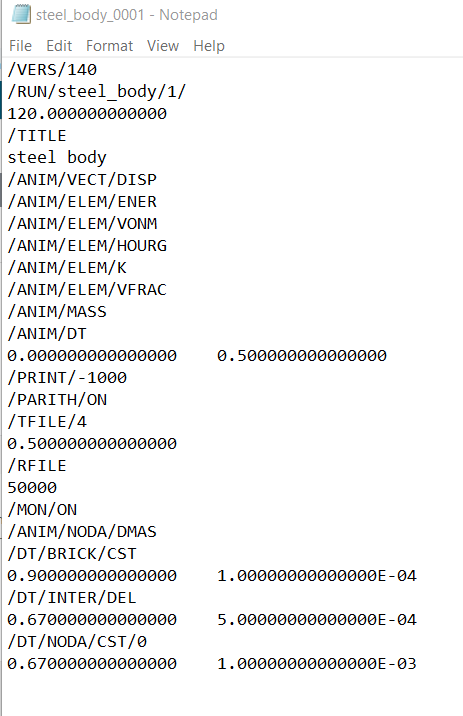
below i attached my engine file input , plss look into my error and correct me
Hi kotian
Is it possible to share the files which you are working on.
I believe that you are using Radioss solver.
You need to check your output control card to set the output format to h3d.
If you are using HyperForm, in default settings, there is a command: -noh3d >> this command set that no h3d file will be create.
>> you can change the setting by 'preference >> hypeform settings'
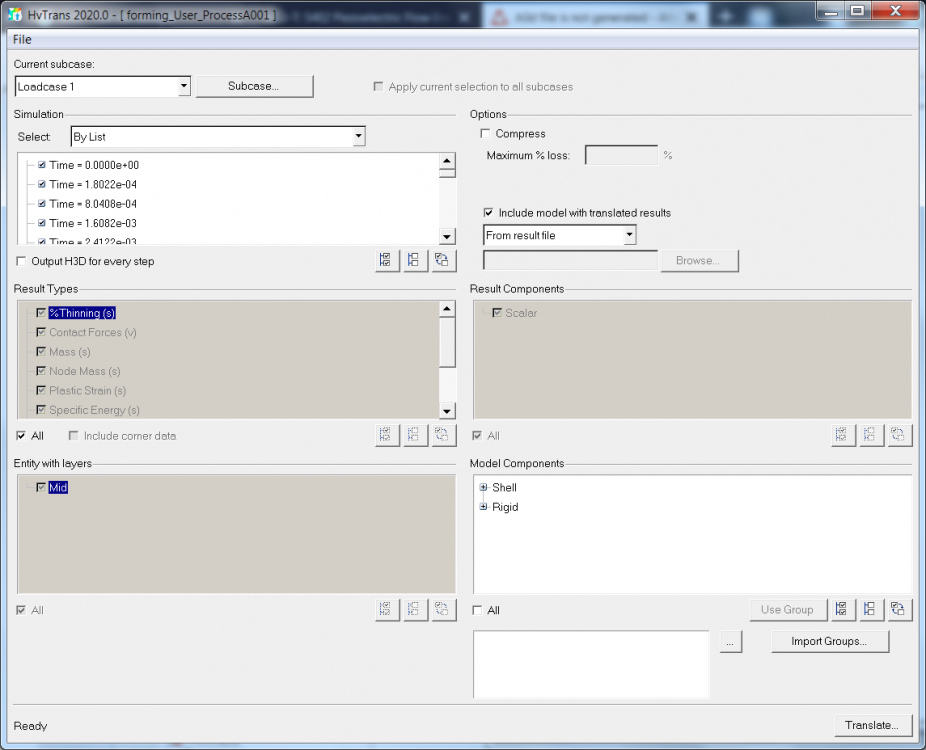
In case you have already completed your simulation and it takes a lot of time for rerun, you can use HVtrans to create the h3d file. (you will find this tool in start menu >> just key in the name).
Use HV trans to open animation files (.A001 in the run folder) then select the timestep, result type, components and translate
It is very easy to use.<?xml version="1.0" encoding="UTF-8"?>
As i am new user to hypermesh , just learn the concept behind that, want to implicate , as i am using student version so HVtrans tool is not available for me ...
below i attached my project file . still i am not available to generate .h3d file , please look into my doubt
Unable to find an attachment - read this blog
You are not getting the .h3d file because the run is getting terminated when the energy error and mass error limit is reached.
Open the 001.OUT file and go through the errors and correct it.
Interface Id 1 is causing the min time step error. Check the reliability of the time step values you imposed here.
<?xml version="1.0" encoding="UTF-8"?>
Join us for a community conversation on how High-Performance Computing (HPC) and Simcenter PSIM work together to meet the increasing demands of modern power electronics simulation. During this one-hour technical session, you'll discover how leveraging HPC can speed up simulations, improve scalability, and empower engineers…
Join us for a community conversation on accelerating your motor simulation workflow with Simcenter Simlab. In this beginner-friendly session, we'll introduce the platform's automated model-building capabilities and show how easy it is to set up your first electric motor analysis. You'll see the basic steps of geometry…
Join us for a Community Conversation where we'll discuss practical approaches to analyzing complex electromagnetic models using hybrid solver techniques. This session will provide a general overview of how different computational methods can be combined within a single simulation to address models containing varied…