The Siemens Community Catalyst program was co-created with our community to acknowledge technology leaders who consistently contribute to the Siemens Community. Nominations are accepted on a rolling basis.
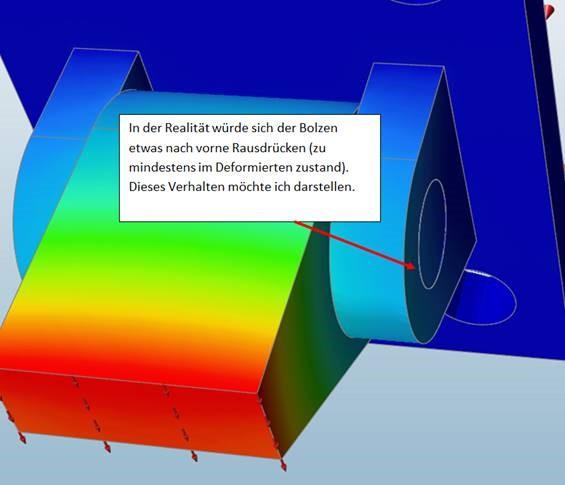
Hello, I have two questions: 1) Is it possible to create a sliding contact in solidThinking INSPIRE like shown in the picture below?2) How can I create such a type of contact by using HyperMesh and OptiStruct instead? Best Regards
Here is the picture for the described issue. I want to have a sliding contact between the bolt and the bending beam.
<?xml version="1.0" encoding="UTF-8"?>
Hello,
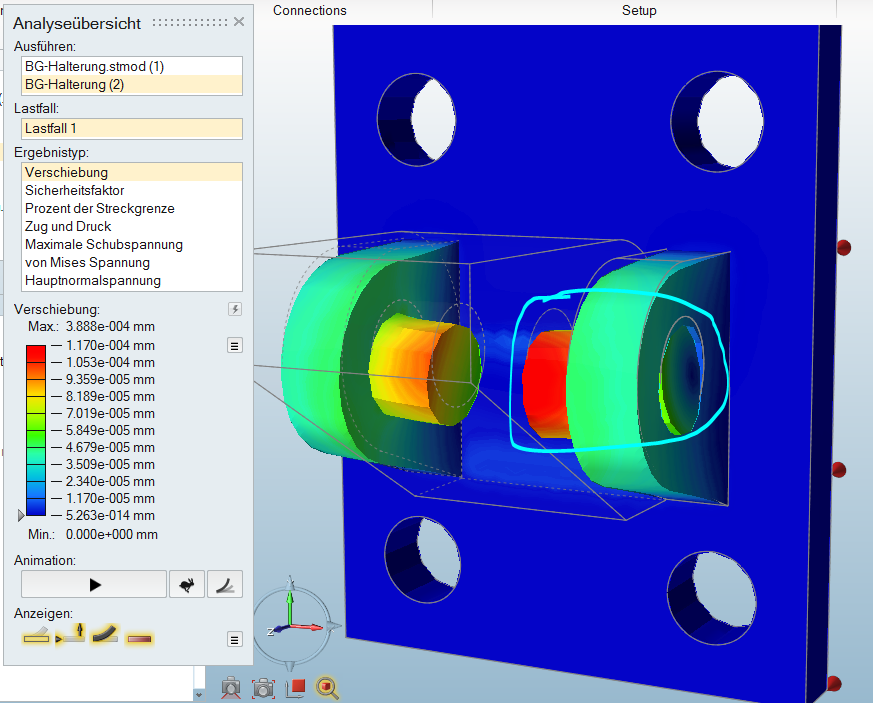
1) The solution would be to use INSPIRE 2015, as the previous versions only allow tied (fixed) contact between two parts. INSPIRE 2015 however let's the user decide what type of contact should be used. See the attached picture for a reference. Currently, the 2015 version is available as Beta version and will be released soon.
2) To define the contact in OptiStruct, use HyperMesh to prepare the contact of type 'sliding'. To do so, go to Tools --> AutoContact to automatically detect the collision / contact between two parts. Set the type to sliding and create the contact definition. You might need to add additional constraints to prevent the bolts from rotating or falling out. To use the contact in your loadstep, switch the type to Non Linear Quasi Static and add the 'NLPARM' card (via loadcollector --> card image NLPARM). See the video below for reference. http://screencast.com/t/rb3pK8vZ2r
Best Regards
Jan
Hello,Thanks it Works, but when I try to Optimization, i get an Error message: 'FEASIBLE DESIGN (ALL CONSTRAINTS SATISFIED).'What is the Problem?ThanksNick.p
Hello Nick,
this is not an error but a success message. It means that your optimization has converged and a design could be found that satisfies all optimization objectives and constraints. See the extract from the help:
'Regular convergence (design is feasible) is achieved when the convergence criteria are satisfied for two consecutive iterations. This means that for two consecutive iterations, the change in the objective function is less than the objective tolerance and constraint violations are less than 1%'
So congratulations on your succesful optimization /emoticons/default_smile.png' alt=':)' srcset='/emoticons/smile@2x.png 2x' width='20' height='20'>
Join us for a community conversation on how High-Performance Computing (HPC) and Simcenter PSIM work together to meet the increasing demands of modern power electronics simulation. During this one-hour technical session, you'll discover how leveraging HPC can speed up simulations, improve scalability, and empower engineers…
Join us for a community conversation on accelerating your motor simulation workflow with Simcenter Simlab. In this beginner-friendly session, we'll introduce the platform's automated model-building capabilities and show how easy it is to set up your first electric motor analysis. You'll see the basic steps of geometry…
Join us for a Community Conversation where we'll discuss practical approaches to analyzing complex electromagnetic models using hybrid solver techniques. This session will provide a general overview of how different computational methods can be combined within a single simulation to address models containing varied…