The Siemens Community Catalyst program was co-created with our community to acknowledge technology leaders who consistently contribute to the Siemens Community. Nominations are accepted on a rolling basis.
Hello everyone!
I have a quesiton about nFX Tool '1 Click SPH Generation'. The first parameter to be set is the 'Particle Spacing'.
What exactly does this parameter mean and which unit has it?
Thank you!
Hi,
Particle spacing is the distance between adjacent particles in the global coordinate. The particles are uniformly distributed along the global XYZ axis. This spacing is used when generating the particles for stationary parts, moving parts and the fluid regions.
The above information I took from SimLab help page. After opening the '1 Click SPH creation' tool, press F1 will take you to the help page about this tool.
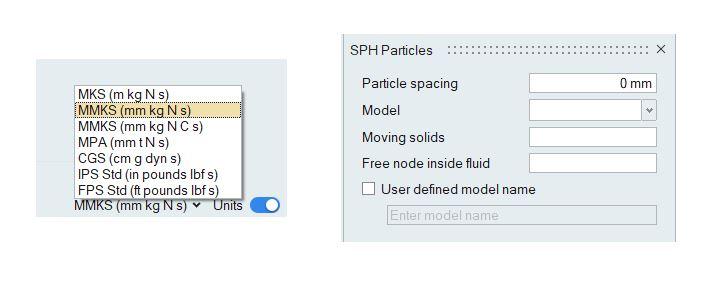
If you are using SimLab 2019.3 or later version, we have introduced unit system in SimLab. Refer the attached image.
If you are using older versions of SimLab, Specify the value for particle spacing based on model units. For example, if the model imported in Meter, then specify the particle spacing value in Meters. You have to make sure that the units are consistent.
<?xml version="1.0" encoding="UTF-8"?>
Hey,
thanks for your help!
Join us for a community conversation on how High-Performance Computing (HPC) and Simcenter PSIM work together to meet the increasing demands of modern power electronics simulation. During this one-hour technical session, you'll discover how leveraging HPC can speed up simulations, improve scalability, and empower engineers…
Join us for a community conversation on accelerating your motor simulation workflow with Simcenter Simlab. In this beginner-friendly session, we'll introduce the platform's automated model-building capabilities and show how easy it is to set up your first electric motor analysis. You'll see the basic steps of geometry…
Join us for a Community Conversation where we'll discuss practical approaches to analyzing complex electromagnetic models using hybrid solver techniques. This session will provide a general overview of how different computational methods can be combined within a single simulation to address models containing varied…