The Siemens Community Catalyst program was co-created with our community to acknowledge technology leaders who consistently contribute to the Siemens Community. Nominations are accepted on a rolling basis.
Hi,
when I try to run a simulation with Radioss (student edition), solver manager shows me:
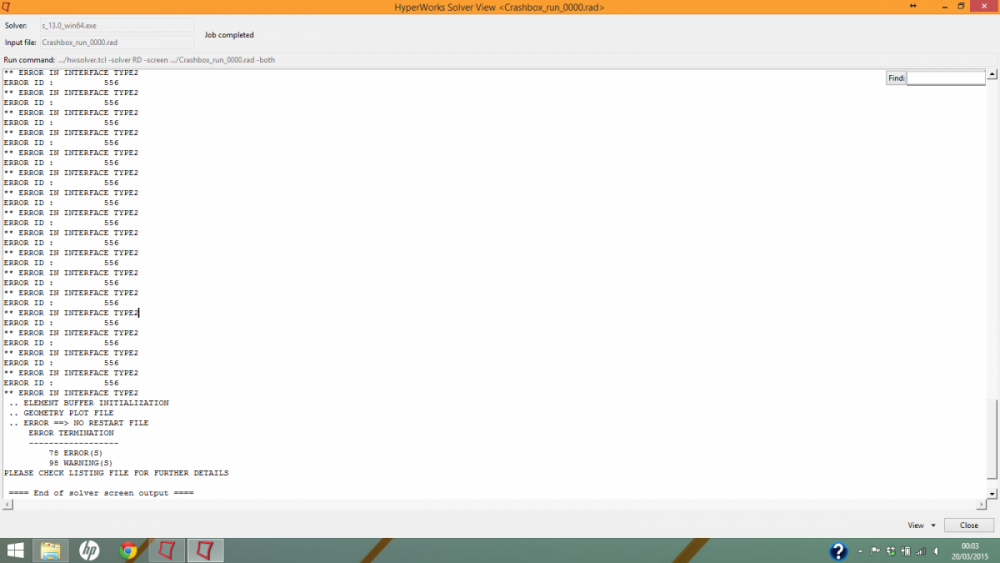
Error in Interface type 2
Error ID 556.
What Can I do to resolve it?
Thanks
Hi Salvinho,
Could you paste the complete error message?
Looks like the master nodes and slave nodes are dependent on each other.
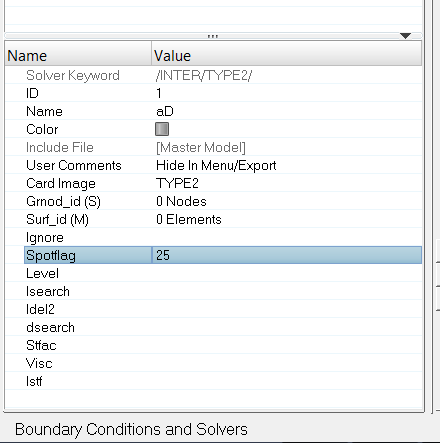
Can you set the SpotFlag= 25 in TYPE2 interface and run the analysis and check if it would help you through the errors?
I attached error image.
If I set Spotflag=25 in type 2, error doesn't appear. Probably you have solved my problem :-)
<?xml version="1.0" encoding="UTF-8"?>
Thanks for the update.
Hi Salvinho, Could you paste the complete error message? Looks like the master nodes and slave nodes are dependent on each other. Can you set the SpotFlag= 25 in TYPE2 interface and run the analysis and check if it would help you through the errors?
I am using OptiStruct but for geom. non-linear analysis of my model Radioss is used as the Radioss starter is run.
How can I introduce the Spotflag=25 for TYPE2 in my input deck or via the OptiStruct GUI?
I have found teh information
The main goal for interface type 2 using penalty method is to tie slave node to master segment without any kinematic constraints. Using the penalty method may avoid 'INCOMPATIBLE KINEMATIC CONDITIONS'.
I have a lot of overlapping or adjacent Freeze Contacts for my linear static simulation in order to tie different parts together so often two or more interfaces share the same node and it is not possible to only define a slave node for only one interface as the error indicates. For OptiStruct this is not a problem but for Radioss apparently it is. Can I suppress this error somehow with introducing Spotflag=25 to my OptiStruct deck?
Hi msc,
Can you please share the model file and out file
@msc I hope this helps
Join us for a community conversation on how High-Performance Computing (HPC) and Simcenter PSIM work together to meet the increasing demands of modern power electronics simulation. During this one-hour technical session, you'll discover how leveraging HPC can speed up simulations, improve scalability, and empower engineers…
Join us for a community conversation on accelerating your motor simulation workflow with Simcenter Simlab. In this beginner-friendly session, we'll introduce the platform's automated model-building capabilities and show how easy it is to set up your first electric motor analysis. You'll see the basic steps of geometry…
Join us for a Community Conversation where we'll discuss practical approaches to analyzing complex electromagnetic models using hybrid solver techniques. This session will provide a general overview of how different computational methods can be combined within a single simulation to address models containing varied…