The Siemens Community Catalyst program was co-created with our community to acknowledge technology leaders who consistently contribute to the Siemens Community. Nominations are accepted on a rolling basis.
dear all
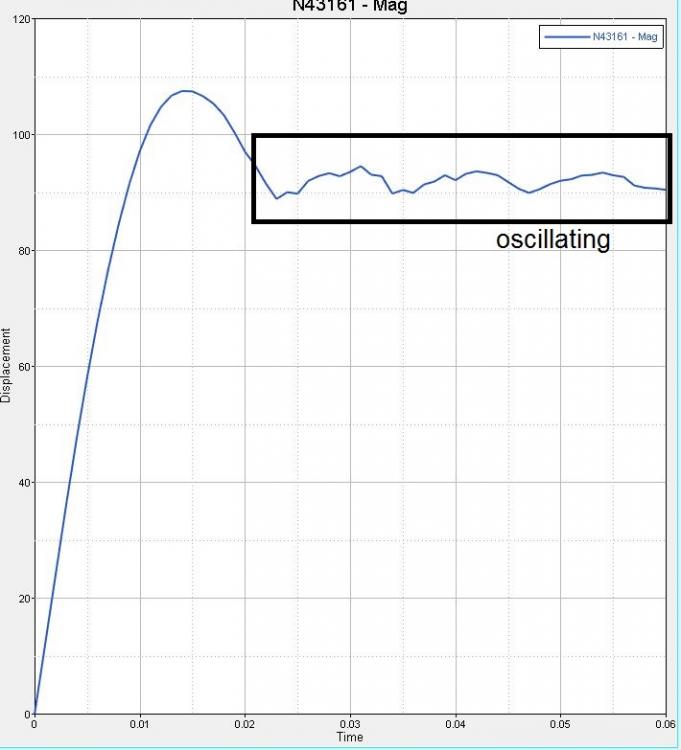
I have made a impacting analysis, but after impacting the object is oscillating. how to add damping to the model to remove the oscillating? Thanks!<?xml version="1.0" encoding="UTF-8"?>
Hi,
Can you elaborate bit more?.
If possible, please share the files to my dropbox (input files, out files, .h3d and T01file)
Hi, Can you elaborate bit more?. If possible, please share the files to my dropbox (input files, out files, .h3d and T01file)
Thanks for your answering. But I can not open your dropbox, I uploaded files there.
Unable to find an attachment - read this blog
This model behavior is dependent on the material characteristics provided and also 2 mm thick. And the boundary conditions also play a role in this,
This is the desired behavior of the model in this loading condition.
Hi, This model behavior is dependent on the material characteristics provided and also 2 mm thick. And the boundary conditions also play a role in this, This is the desired behavior of the model in this loading condition.
hi,
Thanks for your answering!
You mean the oscillating can not be removed by adding damping? If it is possible, how to add damping?
For defining damping in Radioss, you can use /DAMP keyword in engine file. This keyword can be used to define the Rayleigh mass and stiffness damping coefficients applied to a set of nodes.
To know about the input parameters, please refer our help menu.
Please refer this example where damping is applied: http://www.altairuniversity.com/wp-content/uploads/2012/08/Example_16.pdf
Hi, For defining damping in Radioss, you can use /DAMP keyword in engine file. This keyword can be used to define the Rayleigh mass and stiffness damping coefficients applied to a set of nodes. To know about the input parameters, please refer our help menu. Please refer this example where damping is applied: http://www.altairuniversity.com/wp-content/uploads/2012/08/Example_16.pdf
Thanks!
Join us for a community conversation on how High-Performance Computing (HPC) and Simcenter PSIM work together to meet the increasing demands of modern power electronics simulation. During this one-hour technical session, you'll discover how leveraging HPC can speed up simulations, improve scalability, and empower engineers…
Join us for a community conversation on accelerating your motor simulation workflow with Simcenter Simlab. In this beginner-friendly session, we'll introduce the platform's automated model-building capabilities and show how easy it is to set up your first electric motor analysis. You'll see the basic steps of geometry…
Join us for a Community Conversation where we'll discuss practical approaches to analyzing complex electromagnetic models using hybrid solver techniques. This session will provide a general overview of how different computational methods can be combined within a single simulation to address models containing varied…