The Siemens Community Catalyst program was co-created with our community to acknowledge technology leaders who consistently contribute to the Siemens Community. Nominations are accepted on a rolling basis.
Hi,
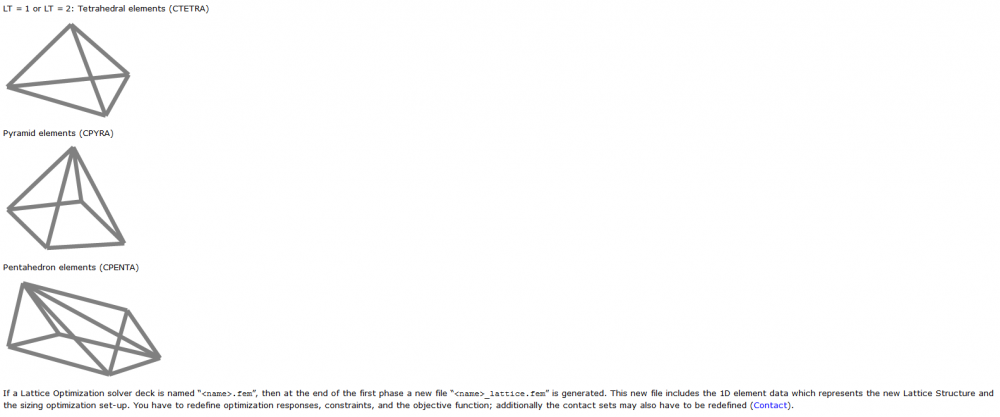
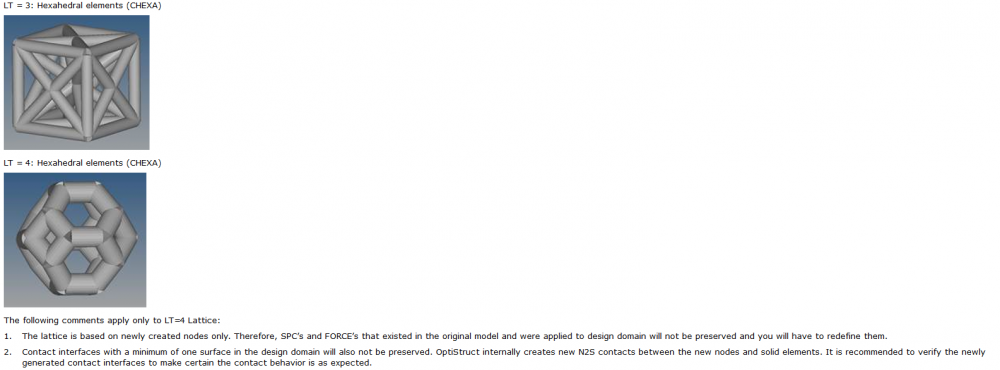
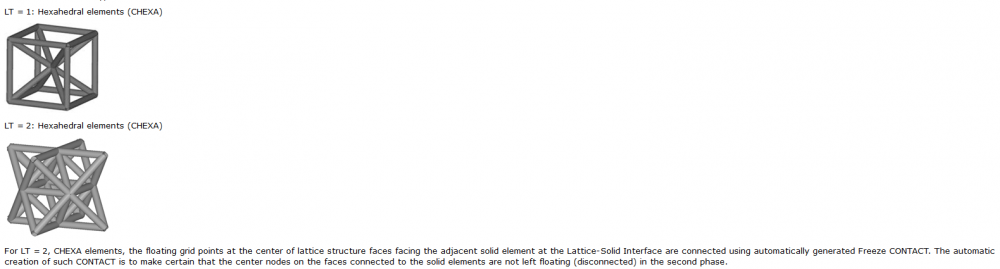
Does anyone know what is the difference between different lattice types( type 1, 2 , 3 and 4) in lattice optimization by Optistruct? And how can I get their properties after optimization?
Thank you,
Hi @smare104
Maybe this pictures can help you /emoticons/default_smile.png' srcset='/emoticons/smile@2x.png 2x' title=':)' width='20'>
<?xml version="1.0" encoding="UTF-8"?>
Thank you very much @Prakash Pagadala. It was really helpful.
Regards,
Soraya
@Prakash Pagadala I am using the student version of Altair and I did the lattice optimization for a beam. I ran the optimization 4 times by using different lattice types in each trial. At the end I am getting the same results for any type of lattice. It means the lattice part in the optimized beam is the same for all cases. I was wondering if you know why this is happening?
What type of elements are available in your model. Type of element will affect the lattice type.
Hi @Prakash Pagadala thank you for the reply. I used tetra elements. I changed my mesh elements to Quad I could get different lattice types in final result.
So does it mean I should use quad elements to get different lattice types?
Thanks,
Hi Soraya,
With tetra you may not get different lattice types. I prefer HEXAs over tetras.
Join us for a Community Conversation where we'll discuss practical approaches to analyzing complex electromagnetic models using hybrid solver techniques. This session will provide a general overview of how different computational methods can be combined within a single simulation to address models containing varied…
Join us for a community conversation to explore how different modeling approaches in Simcenter PSIM can help engineers simulate power electronics systems while balancing accuracy, simulation speed, and design insight. What you'll learn: Power transistor modeling : Thermal and high fidelity models Protection component…