The Siemens Community Catalyst program was co-created with our community to acknowledge technology leaders who consistently contribute to the Siemens Community. Nominations are accepted on a rolling basis.
Hi
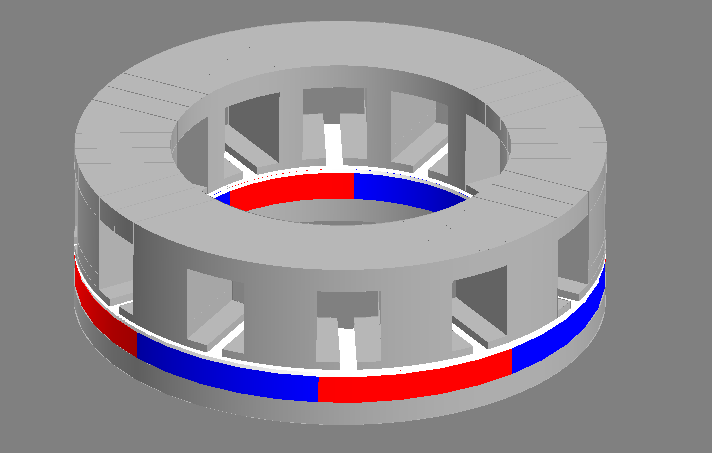
I was wondering to know how to calculate the PM loss in 3D.
I use solid coil in 2D but this approach is not possible in 3D. Can you guide me how to do it.
Thank you in advance.
Best regards,
Hi,
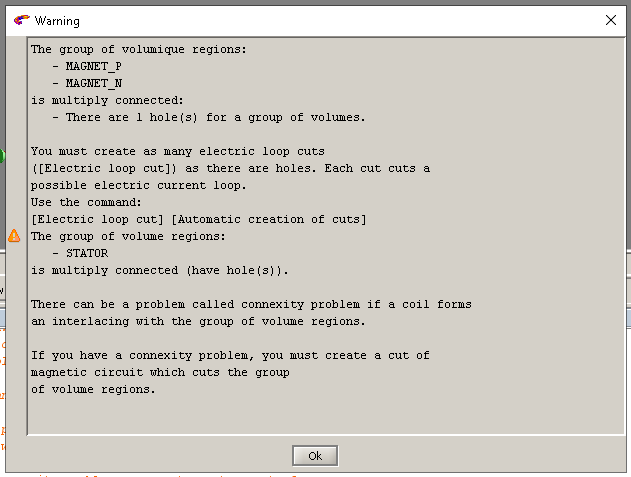
You need to follow the same steps as in Flux 2D. But in Flux 3D you need to define the input an output of the current inside the solid conductor regions. To do it:
Physics >> assign terminals to solid conductors >> assign terminals to solid conductors 2 terminals
Best regards.
Thank you for you guidance.
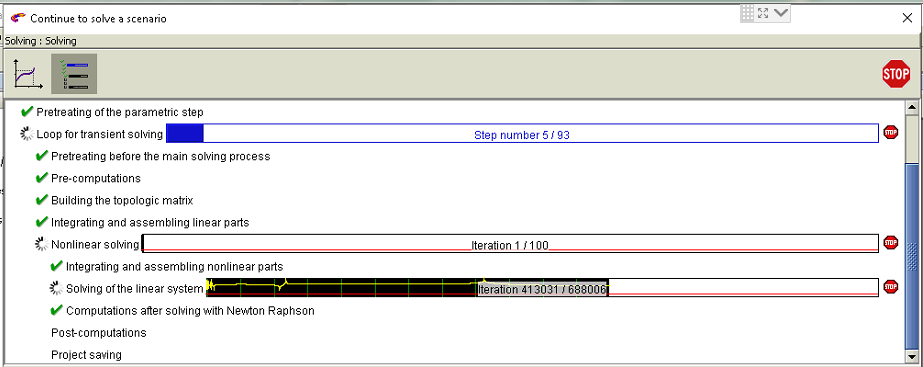
I have done the same but there is a problem related to the time of simulation. I think there is a problem in the model because without considering the 'PM loss using solid conductors' the simulation time was around 2 hours (102 steps) but considering the 'PM loss using solid conductors' has been taken around 5 days just for 5 steps.
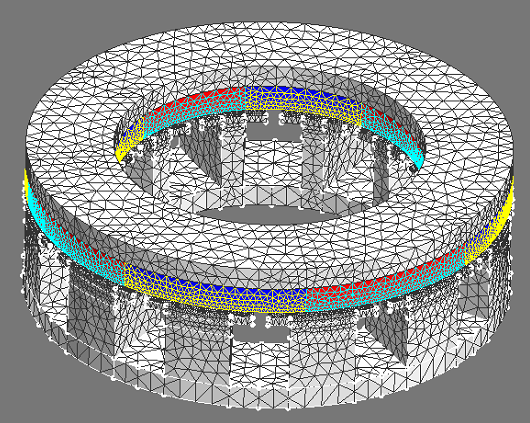
Is the problem related to mesh? Can you guide me to solve the problem and speed up the simulation time?
Yours faithfully,
In Flux 3D when you use a solid conductor region, you force the mesh to second order. This means that the number of nodes increase. When the number of nodes increase the simulation time increase. You can check the number of nodes when you use the magnetic non conducting region and solid conductor region, you will find that the number of nodes it is not the same.
You can use the computation distribution to decrease the simulation time.
Thank you so much for your explanations.
Kind regards,
You are welcome.
Join us for a community conversation on how High-Performance Computing (HPC) and Simcenter PSIM work together to meet the increasing demands of modern power electronics simulation. During this one-hour technical session, you'll discover how leveraging HPC can speed up simulations, improve scalability, and empower engineers…
Join us for a community conversation on accelerating your motor simulation workflow with Simcenter Simlab. In this beginner-friendly session, we'll introduce the platform's automated model-building capabilities and show how easy it is to set up your first electric motor analysis. You'll see the basic steps of geometry…
Join us for a Community Conversation where we'll discuss practical approaches to analyzing complex electromagnetic models using hybrid solver techniques. This session will provide a general overview of how different computational methods can be combined within a single simulation to address models containing varied…