The Siemens Community Catalyst program was co-created with our community to acknowledge technology leaders who consistently contribute to the Siemens Community. Nominations are accepted on a rolling basis.
How to set orientation for filament winding composites using type 11 card with mat 25
Plz brief on the use of P11_SH_SANDW card.
Hi Jones,
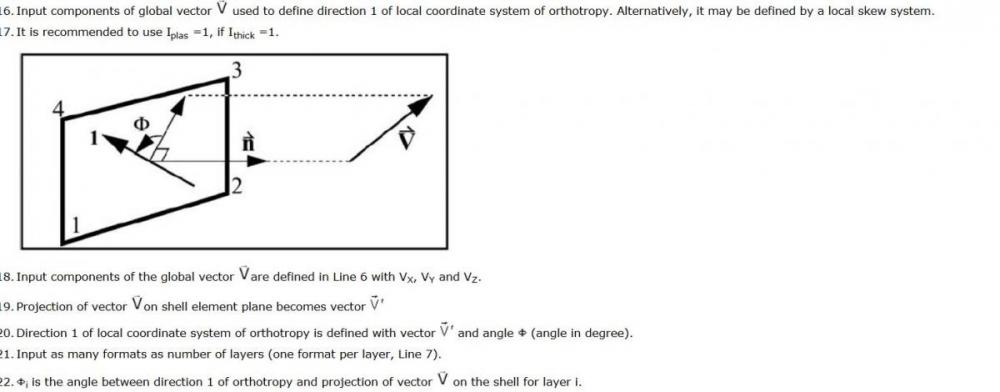
Use PHIi in type prop/type11 card to define orientation.
before that you need to define a global vector which define the material direction.
Many Thanks Prakash.
Could you please briefly explain ur answer
I'm working on Zone based multi directional and bi-directional plies,in that case how many co-ordinate systems had to be created and How??
or send help link regarding that if poss.
Regards,
Jones
You can find more information about TYPE 11 property in RADIOSS starter help.
Please refer to help to learn more on this.
In your case, you need one property for one zone.
<?xml version="1.0" encoding="UTF-8"?>
can anyone tell me how to define bidirectional ply orientation in optistruct and block 110
thanks
Hi Jessica,
BiDirectional ply definition is based on Material property. If E11 and E22 are same in MAT8 card then the ply is assumed as bi-directional.
If the case is reverse, that is E11>> E22 then it is a uni-directional ply.
HI Prakash, I got a doubt reg the same, I have underwent many analysis on Mat 8 card with UD composites....As u are telling that if E11 & E22 are same,Software will consider it as bidirectional. How to assume the difference between UD and BD? will the same be reflected in the result?
Jones,
You will see the difference in the results.
Consider a UD.. The strength will be much greater in the major direction when compared to the minor direction (or less stiffer)
in the same way, BD will possess similar or almost near strength in both major and minor directions.
Join us for a community conversation on how High-Performance Computing (HPC) and Simcenter PSIM work together to meet the increasing demands of modern power electronics simulation. During this one-hour technical session, you'll discover how leveraging HPC can speed up simulations, improve scalability, and empower engineers…
Join us for a community conversation on accelerating your motor simulation workflow with Simcenter Simlab. In this beginner-friendly session, we'll introduce the platform's automated model-building capabilities and show how easy it is to set up your first electric motor analysis. You'll see the basic steps of geometry…
Join us for a Community Conversation where we'll discuss practical approaches to analyzing complex electromagnetic models using hybrid solver techniques. This session will provide a general overview of how different computational methods can be combined within a single simulation to address models containing varied…