The Siemens Community Catalyst program was co-created with our community to acknowledge technology leaders who consistently contribute to the Siemens Community. Nominations are accepted on a rolling basis.
Hi,
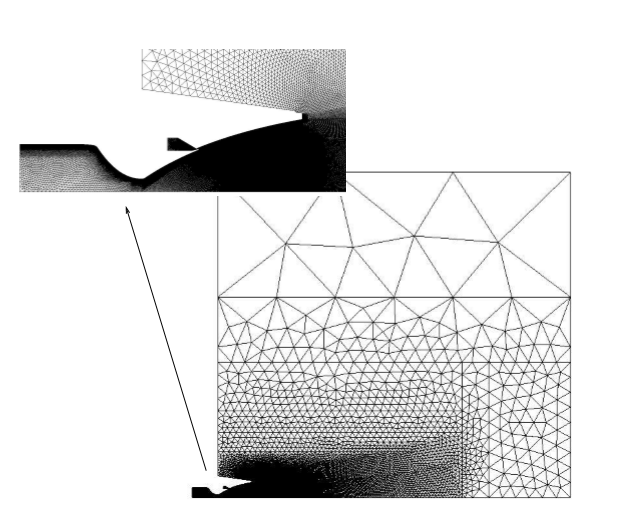
I would like to know how to mesh a component more and more thinner with a growth rate like on this figure. Can anyone help me to find out how to do it please ?
It for a rectangle (2D component).
Thanks, regards,
Charlotte
Hello,
You can do this in a couple of ways.
Firstly, you can mesh the entire component with a similar element size and then increase the density of the mesh as you go along the edge.
<?xml version="1.0" encoding="UTF-8"?>
OR
You can split the surface in multiple and mesh separately each split according to your requirement.
Thank you
Ok thank you for your reply.
It works but I didn't specify that I wanted only squared elements. And when I put a different density to opposite side of the rectangle, triangle elements appears.
So I use the same density on opposite sides but introduce a biasing. It works for an intensity of 1 or -1, but when I put more than an intensity of 1 (because I would like to have smaler elements in a angle), there are trangles again.
(I used the minimu size of element (0.05) when i firstly mesh the component).
Would you know how to keep squared elements and have smaller elements?
Regards,
You can always try and control the element shape from the below shown panel.
But i don't think you will get all squared elements as the mesh is not constant.
Thankyou
Hi, Ok thank you for your reply. It works but I didn't specify that I wanted only squared elements. And when I put a different density to opposite side of the rectangle, triangle elements appears. So I use the same density on opposite sides but introduce a biasing. It works for an intensity of 1 or -1, but when I put more than an intensity of 1 (because I would like to have smaler elements in a angle), there are trangles again. (I used the minimu size of element (0.05) when i firstly mesh the component). Would you know how to keep squared elements and have smaller elements? Regards, Charlotte
Don't forget : if you add more meshing contraintes, the quality will decreased. So you have to accept some compromises.
C'est la vie :-)
Hi everyone,
Yes it's true I don't get only squared even if I controle the shape of the elements. but thanks for replying.
Ahah I understand, it wouldn't be physical anymore, if they were only squares. J'ai trouvé un compromis /emoticons/default_smile.png' srcset='/emoticons/smile@2x.png 2x' title=':)' width='20' />
Hi everyone, Yes it's true I don't get only squared even if I controle the shape of the elements. but thanks for replying. Ahah I understand, it wouldn't be physical anymore, if they were only squares. J'ai trouvé un compromis /emoticons/default_smile.png' srcset='/emoticons/smile@2x.png 2x' title=':)' width='20' /> Charlotte
Hey, triangular elements are NOT 'bad' elements :-)
Bonne continuation!
Join us for a community conversation on how High-Performance Computing (HPC) and Simcenter PSIM work together to meet the increasing demands of modern power electronics simulation. During this one-hour technical session, you'll discover how leveraging HPC can speed up simulations, improve scalability, and empower engineers…
Join us for a community conversation on accelerating your motor simulation workflow with Simcenter Simlab. In this beginner-friendly session, we'll introduce the platform's automated model-building capabilities and show how easy it is to set up your first electric motor analysis. You'll see the basic steps of geometry…
Join us for a Community Conversation where we'll discuss practical approaches to analyzing complex electromagnetic models using hybrid solver techniques. This session will provide a general overview of how different computational methods can be combined within a single simulation to address models containing varied…