The Siemens Community Catalyst program was co-created with our community to acknowledge technology leaders who consistently contribute to the Siemens Community. Nominations are accepted on a rolling basis.
Submitted by Joe on Fri, 04/20/2012 - 20:28
Hi I was using Up/Down count and everything was working fine. Then I switched to Up Count but I can not get the expected PWM waveforms on my oscilloscope. Anything wrong? Please help me.
Submitted by Anders89 on Fri, 04/20/2012 - 20:30.
The F28x ePWM module has a 16 bit counter for which you set a period. When it counts up to the period it can either start counting back down (Up/Down mode) or restart at zero (Up node). This is set in the Count Mode field. There are 2 output pins for each PWM unit, A & B. There are two corresponding compare registers CMPA and CMPB, which can be used to set the value on the output pin to a logical 1 or 0. The CMPA/B regs are set by the value you provide on the A/B input pins to the ePWM block. The pins expect an fx1.16 (16-bit scaled integer with 1 magnitude bit) value. A value of .2 give a value of 20% of full period to the respective CMP register, a value of .5 give a 50% of full period value to the CMP register and so on. Each A/B output can be affected by 6 possible events:
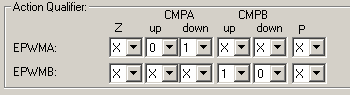
The above events can be used to set the A/B output to a 1, 0, T (toggle) or X (ignored). Below is the relevant portion of the ePWM config screen when you right click on the ePWM block:
The configuration above will use CMPA to modulate the on-time for output A, and CMPB modulates off-time for output B. Note that you have complete flexibility to use CMPA to modulation output B and CMPB to modulate output A, though it is not recommended.The CMPA/B down count match only makes sense if you are doing up/down or down count. If you choose Up count, a Down count match will never happen so you should choose either a Z (zero count) or P (period) match in addition to a CMPA/B Up count match.
Join us for a community conversation on how High-Performance Computing (HPC) and Simcenter PSIM work together to meet the increasing demands of modern power electronics simulation. During this one-hour technical session, you'll discover how leveraging HPC can speed up simulations, improve scalability, and empower engineers…
Join us for a community conversation on accelerating your motor simulation workflow with Simcenter Simlab. In this beginner-friendly session, we'll introduce the platform's automated model-building capabilities and show how easy it is to set up your first electric motor analysis. You'll see the basic steps of geometry…
Join us for a Community Conversation where we'll discuss practical approaches to analyzing complex electromagnetic models using hybrid solver techniques. This session will provide a general overview of how different computational methods can be combined within a single simulation to address models containing varied…