The Siemens Community Catalyst program was co-created with our community to acknowledge technology leaders who consistently contribute to the Siemens Community. Nominations are accepted on a rolling basis.
Submitted by Joe on Thu, 08/04/2011 - 20:14
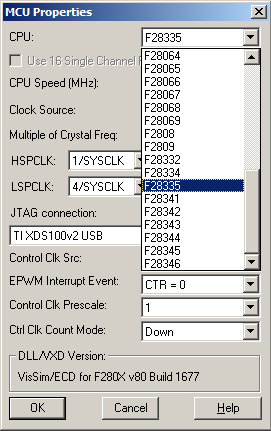
When using Tools > Code Gen to create a .out file, I don't see the F28335 processor option in the main target list. How can I select the F28335 processor target? Please reply us as soon as possible.
Submitted by Anders89 on Thu, 08/04/2011 - 20:32.
The F28335 is considered a subtarget of the F280x family as the peripherals like ePWM and ADC are the same on F2808 and F28335. The good news is that there is no extra charge for F28335 (Delfino) support or F28035 (Piccolo) support. They are both considered subtypes of the F280x family. However, you must select the proper subfamily target for proper compilation and boot behavior due to some small differences among family members like clock speed and memory layout. To select the subtarget within the F280x family, choose Embedded > Delfino > MCU Config... (or Embedded > Piccolo > MCU Config... or Embedded > F280x > MCU Config...) Then select the desired subtarget from the CPU dropdown list as shown below. In version 8, an MCU config block will be inserted into your diagram so you can just right click it to change subtargets or JTAG emulator in the future.
Join us for a community conversation on how High-Performance Computing (HPC) and Simcenter PSIM work together to meet the increasing demands of modern power electronics simulation. During this one-hour technical session, you'll discover how leveraging HPC can speed up simulations, improve scalability, and empower engineers…
Join us for a community conversation on accelerating your motor simulation workflow with Simcenter Simlab. In this beginner-friendly session, we'll introduce the platform's automated model-building capabilities and show how easy it is to set up your first electric motor analysis. You'll see the basic steps of geometry…
Join us for a Community Conversation where we'll discuss practical approaches to analyzing complex electromagnetic models using hybrid solver techniques. This session will provide a general overview of how different computational methods can be combined within a single simulation to address models containing varied…