https://community.altair.com/discussion/40104/webinar-improving-truck-ride-comfort-using-vehicle-simulations?utm_source=community-search&utm_medium=organic-search&utm_term=iso+%228608%22
I watched this webinar and I'm trying to perform the ride comfort analysis, but I’m facing some issues as follows:
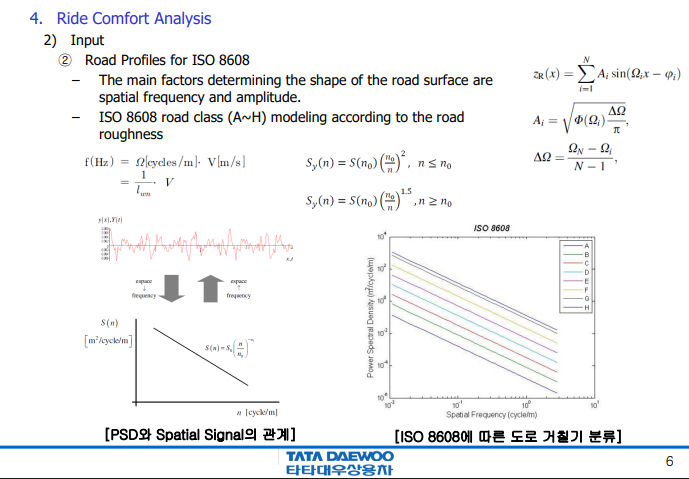
In the input section of the model, I heard the presenter explain that he generated a random road surface based on ISO 8608 and then used it as the input for the full-vehicle analysis.
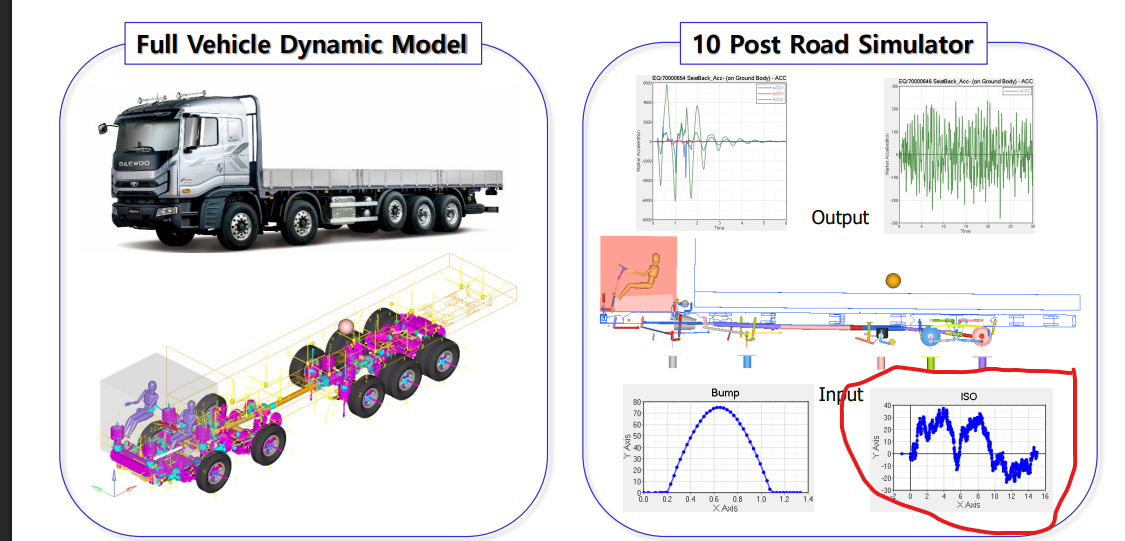
However, I still have a question: For a real vehicle comfort simulation, should the road profile be generated from the ISO 8608 standard, or should it be obtained from actual road-condition measurements?
In addition, if I already have measured data for road elevation and surface height, I can convert it into the frequency domain (SPD) as shown by the presenter. From that, I can identify the road class based on ISO 8608. After comparing my measured data with ISO 8608, should the input for the full-vehicle analysis be the ISO 8608 road data or my actual measured data?
If I continue using my measured data—converted back to time-domain elevation—as the input for the post-shaker analysis, then what is the purpose of comparing it with ISO 8608 in the first place? And what role does the frequency–SPD plot play in this simulation if the road-profile input will ultimately be the time-height data?
Thanks a lot!