The Siemens Community Catalyst program was co-created with our community to acknowledge technology leaders who consistently contribute to the Siemens Community. Nominations are accepted on a rolling basis.
Hi,
How can I add capacitive loads at both ends of my curved wire configuration?
Attached the file.
Thanks
Unable to find an attachment - read this blog
Hello Mohamed Hamdalla,
You can add capacitive loads on the curved wire in the same way that you would add them on any other wire. Define your ports and add your loads. You can define a segment or vertex port to be located anywhere along the wire. There are restrictions for the vertex port and you won't be able to add a vertex port at the end or start of a wire when it is not connected to another wire or a face.
Thank you very much for replay. My concern now is, if I add load at the end of the wire does it mean that the wire is terminated or no?. In other words, the load at the end of the wire is grounded or it is just floating?
Hello Mohamed,
If there is nothing connected to the end of the wire, it will be floating. Think about what the model would like if you built it in real life - soldering a resistor to the end of a wire will result in a floating resistor. The port simply allows you to add a resistor anywhere along the wire (think of it as cutting the wire and soldering the resistor between the two wires).
Thanks. So if I am trying to terminate the wire with impedance to ground, should I use the ground plane and connect my wire through the resistance to the ground?
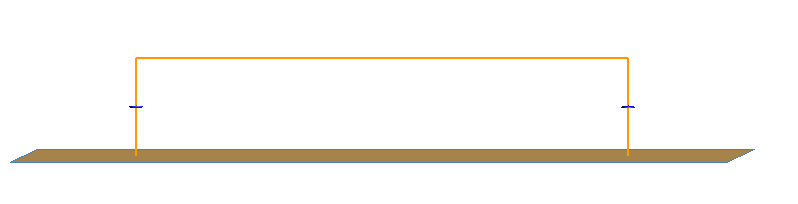
Is this configuration ok?
Yes, the configuration in your image is what I would expect when adding loads close to the end of a wire (in this case you have a single conductor above a ground). It does not have to be an infinite ground as in your example and could be any geometry (as an example, think of a loaded wire connected between cars or any other geometry).
Thanks a lot JIF
Join us for a community conversation on how High-Performance Computing (HPC) and Simcenter PSIM work together to meet the increasing demands of modern power electronics simulation. During this one-hour technical session, you'll discover how leveraging HPC can speed up simulations, improve scalability, and empower engineers…
Join us for a community conversation on accelerating your motor simulation workflow with Simcenter Simlab. In this beginner-friendly session, we'll introduce the platform's automated model-building capabilities and show how easy it is to set up your first electric motor analysis. You'll see the basic steps of geometry…
Join us for a Community Conversation where we'll discuss practical approaches to analyzing complex electromagnetic models using hybrid solver techniques. This session will provide a general overview of how different computational methods can be combined within a single simulation to address models containing varied…