The Siemens Community Catalyst program was co-created with our community to acknowledge technology leaders who consistently contribute to the Siemens Community. Nominations are accepted on a rolling basis.
Hello,
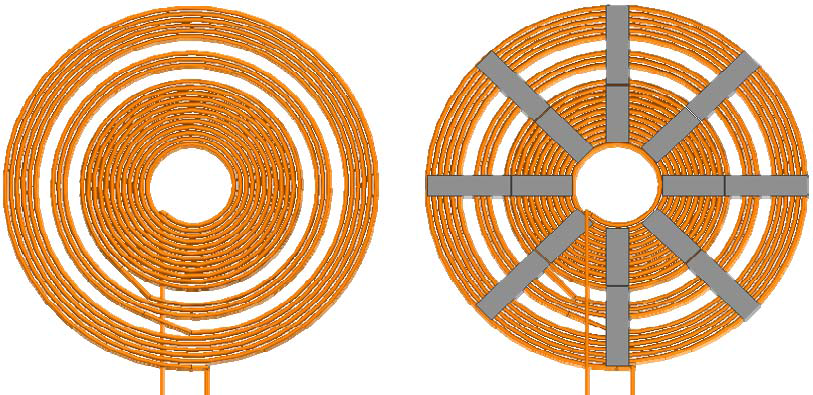
I am working on induction heating cookers. I need to model the coil using litz. so is there a example or documentation that i can use to make the coil. I am attaching the coil type that i have to model.
thank you
Hi,
Unfortunately we don’t have any example about coil using Litz wire. But if you want to take into account of the proximity effect you can use coil conductor region with loss. This region is available only in steady state AC magnetic.
Best regards
Hi, I am also working with induction cooktops.
Could you help me with some models? I aslo want to model that kind of coil.
Hi there,
There are two reliable approaches I've found for modeling litz wire, depending on your simulation needs:
1. Simplified Method (2D Steady-State AC Magnetic – XY or Axisymmetric)This is the more straightforward option. In this case, you define the litz wire’s cross-section as a coil conductor region and assign its electrical characteristics using the Coil Loss Models menu. While limited to 2D steady-state AC magnetic solvers, it’s effective for many typical use cases.
2. Detailed Method (2D/3D Steady-State AC Magnetic)This approach is more detailed but offers broader applicability, including full 3D simulations. You model the litz wire coil as a solid volume (e.g., a tube-like shape) and then apply the resistance value provided by the manufacturer. You’ll need to request this resistance specification from the supplier directly, as it’s based on their internal design.
As a reference, I’ve attached an excellent document from New England Wire Technologies, which provides a trustworthy method for estimating litz wire resistance. It may serve as a helpful guide when applying this method.
Hope this comment helps!
Join us for a community conversation on how High-Performance Computing (HPC) and Simcenter PSIM work together to meet the increasing demands of modern power electronics simulation. During this one-hour technical session, you'll discover how leveraging HPC can speed up simulations, improve scalability, and empower engineers…
Join us for a community conversation on accelerating your motor simulation workflow with Simcenter Simlab. In this beginner-friendly session, we'll introduce the platform's automated model-building capabilities and show how easy it is to set up your first electric motor analysis. You'll see the basic steps of geometry…
Join us for a Community Conversation where we'll discuss practical approaches to analyzing complex electromagnetic models using hybrid solver techniques. This session will provide a general overview of how different computational methods can be combined within a single simulation to address models containing varied…