The Siemens Community Catalyst program was co-created with our community to acknowledge technology leaders who consistently contribute to the Siemens Community. Nominations are accepted on a rolling basis.
Can we directly calculate mutual impedance beween antenna elements? So far I have takes mutual coupling (S-parameters -S12 ) and extracted Z12 from it using formula.
Hello mgvm7,
The easiest way that I can think of to perform the calculation is to export your S-parameters in POSTFEKO to an impedance Touchstone file (.znp file).
how to export S to .znp file?
Hi mgmv7
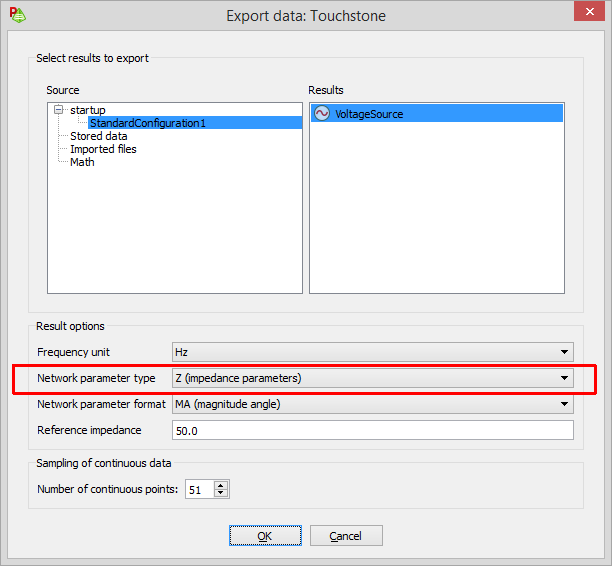
On the Home tab in POSTFEKO, you can select 'Export' and 'Touchstone', select the result to export and then for 'Network parameter type' select 'Z (impedance parameters)'.
thank you @MvdM
Can you tell me how to use lua file?
On the Home tab in CADFEKO or POSTFEKO, click on 'Script editor'. You can open, view, edit and run Lua script files in the script editor.
Refer to the 'Scripting' section under the 'Quick Tour of the CADFEKO Interface' in the Feko 2018 user manual. For more detailed information, see the chapter on 'Scripts and Application Programming Interface (API)'.
For demonstrations of how to use scripting, you can watch the webinars that are available from the Altair HyperWorks Resource Library:
Join us for a community conversation on how High-Performance Computing (HPC) and Simcenter PSIM work together to meet the increasing demands of modern power electronics simulation. During this one-hour technical session, you'll discover how leveraging HPC can speed up simulations, improve scalability, and empower engineers…
Join us for a community conversation on accelerating your motor simulation workflow with Simcenter Simlab. In this beginner-friendly session, we'll introduce the platform's automated model-building capabilities and show how easy it is to set up your first electric motor analysis. You'll see the basic steps of geometry…
Join us for a Community Conversation where we'll discuss practical approaches to analyzing complex electromagnetic models using hybrid solver techniques. This session will provide a general overview of how different computational methods can be combined within a single simulation to address models containing varied…