The Siemens Community Catalyst program was co-created with our community to acknowledge technology leaders who consistently contribute to the Siemens Community. Nominations are accepted on a rolling basis.
I am getting error attached while running on super computer using xming GUI.
I think .so file is missing for linux.
I am trying to replicate Tavares breakage model using API and same model I want to apply to my custom grinding project.
Thanks
Hi,
To compile code to Linux libraries you can find the instructions in the help:
https://help.altair.com/edem/topics/programming_guide/compiling_api_models_to_libraries_t.htm
The Linux section is just over half way down the page above.
Regards
Stephen
Hi
Thank you for the reply.
Could you please let em know how to create the source files like .cpp .h
Thanks,
Narendra
Hello Narendra,
You create the source files (cpp and h) using Microsoft Visual Studio or Visual Studio Code. Starting from scratch can be a challenging task especially if you are new to programming. Thus, I would recommend having a look at the API tutorials available on the Altair Community (for example EDEM API Tutorial 1: Particle Replacement) to get the already defined cpp and h files. Once you are familiar with the structure of the files then you can modify them to address your specific needs. There are also helpful videos on our YouTube channel that you can watch to understand how to modify / compile API models Intro to EDEM API – Part 1 to 3Kind Regards,
Eric
How i can access the .cpp and .h files of breakage in the Tavares breakage model?
I downloaded the entire zip but i couldn't find. Could you please provide those files.
And also when I am running simulations on linux GUI i am getting the error like this. How to solve this.
Hi, How i can access the .cpp and .h files of breakage in the Tavares breakage model? I downloaded the entire zip but i couldn't find. Could you please provide those files. Thanks, Narendra
I do not believe that the .cpp and .h files are made publicly available. You can access the already compiled .so file to run the Tavares breakage model with the API here, you need to download the API zipped folder: https://community.altair.com/community/en/tavares-breakage-model-in-edem-overview-and-download?sys_kb_id=4105e184dbe94190cfd5f6a4e296197c&id=kb_article_view&sysparm_rank=2&sysparm_tsqueryId=3d5331eb97378650da583b47f053af49,
or you can use the built-in version of the Tavares breakage model in EDEM.Kind Regards,
Hello Narendra, I do not believe that the .cpp and .h files are made publicly available. You can access the already compiled .so file to run the Tavares breakage model with the API here, you need to download the API zipped folder: https://community.altair.com/community/en/tavares-breakage-model-in-edem-overview-and-download?sys_kb_id=4105e184dbe94190cfd5f6a4e296197c&id=kb_article_view&sysparm_rank=2&sysparm_tsqueryId=3d5331eb97378650da583b47f053af49, or you can use the built-in version of the Tavares breakage model in EDEM.Kind Regards, Eric
But all other examples have them in their folder.
Then how can i understand what it is doing exactly I mean in the code.
But all other examples have them in their folder. Then how can i understand what it is doing exactly I mean in the code. Thanks, Narendra
Hi Narendra,
The source code is not made available due to the proprietary methods used to implement the Tavares breakage model. Rest assured; the implementation of the model has been done with the collaboration of Dr. Tavares. To understand how the model is working I would suggest that you review the Model_Documentation.zip file that is included in the link I shared above. You can also find information on the Tavares breakage model in the EDME Help documentation: https://help.altair.com/EDEM/topics/creator_tree_physics/the_tavares_ufrj_breakage_model_r.htm
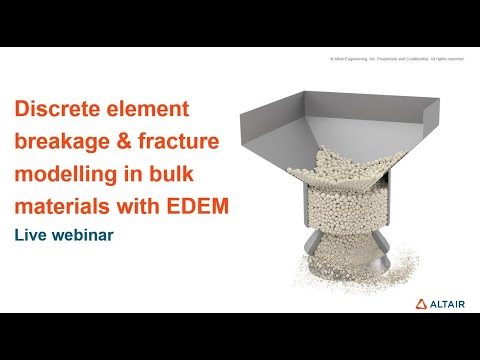
You might also find the following webinar helpful: https://www.youtube.com/watch?v=zqHjpWlUkWgKind Regards,
Join us for a community conversation on how High-Performance Computing (HPC) and Simcenter PSIM work together to meet the increasing demands of modern power electronics simulation. During this one-hour technical session, you'll discover how leveraging HPC can speed up simulations, improve scalability, and empower engineers…
Join us for a community conversation on accelerating your motor simulation workflow with Simcenter Simlab. In this beginner-friendly session, we'll introduce the platform's automated model-building capabilities and show how easy it is to set up your first electric motor analysis. You'll see the basic steps of geometry…
Join us for a Community Conversation where we'll discuss practical approaches to analyzing complex electromagnetic models using hybrid solver techniques. This session will provide a general overview of how different computational methods can be combined within a single simulation to address models containing varied…