The Siemens Community Catalyst program was co-created with our community to acknowledge technology leaders who consistently contribute to the Siemens Community. Nominations are accepted on a rolling basis.
Hello,
How to define in FEKO the Side Lobe Level (SLL) goal?
Thanks in Advance.
Best Regards
Haj Hassan
Dear @Haj Hassan
I don't think it is currently possible to define SLL directly as an optimization goal in Feko, but it should be possible to define an indirect goal to achieve this.
<?xml version="1.0" encoding="UTF-8"?>
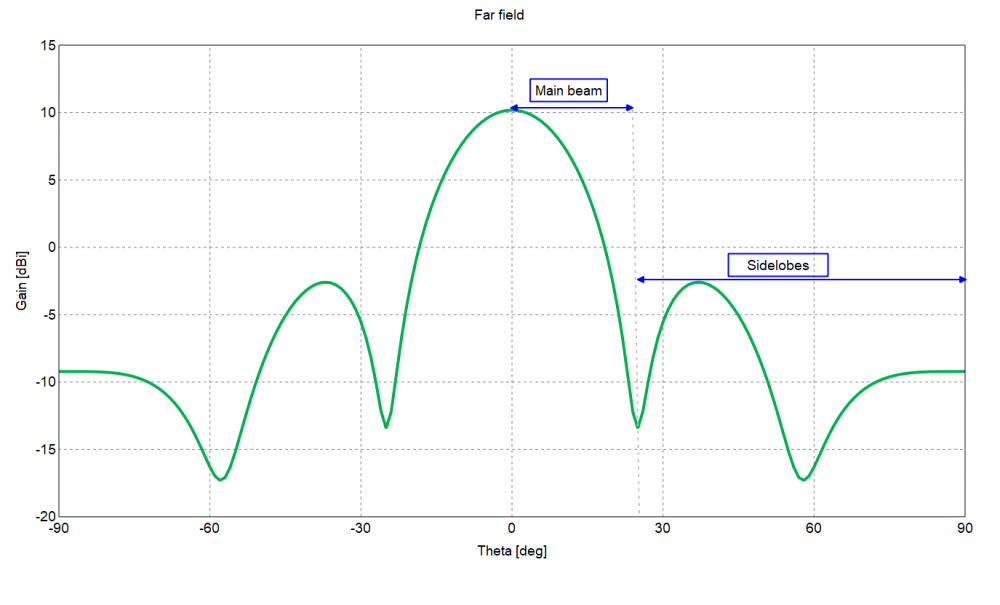
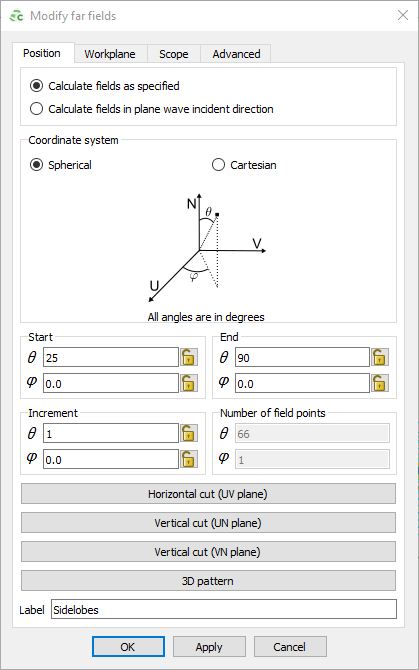
If you consider the gain of a 5-dipole linear array as in the graph above, you will see that the side lobe is defined as the maximum gain value outside the main beam. If we then minimize this value, we should reduce the SLL. We can achieve this by requesting a far field cut outside the main beam. In the example above this would be for Theta from 25 to 90 degrees. Let us call this far field request 'Sidelobes':
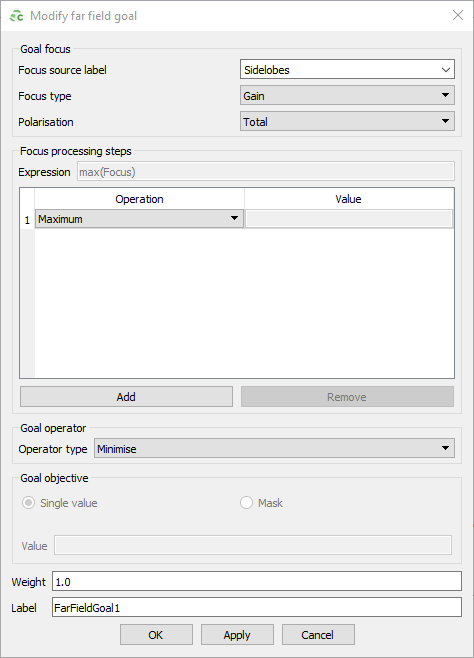
We can then define a goal as follows:
This goal would then aim to reduce the highest peak outside the main lobe - which would reduce the SLL.
It is important to note that the above goal does not consider the main beam gain value. If your optimization parameters might also affect your main beam gain, you would have to also include a goal to maximize your main beam gain or to optimize it to be equal to a required value. You might also have to play around with the 'Weight' values of these two goals to achieve the best results.
Thank you very much.
This is very helpful.
Join us for a community conversation on how High-Performance Computing (HPC) and Simcenter PSIM work together to meet the increasing demands of modern power electronics simulation. During this one-hour technical session, you'll discover how leveraging HPC can speed up simulations, improve scalability, and empower engineers…
Join us for a community conversation on accelerating your motor simulation workflow with Simcenter Simlab. In this beginner-friendly session, we'll introduce the platform's automated model-building capabilities and show how easy it is to set up your first electric motor analysis. You'll see the basic steps of geometry…
Join us for a Community Conversation where we'll discuss practical approaches to analyzing complex electromagnetic models using hybrid solver techniques. This session will provide a general overview of how different computational methods can be combined within a single simulation to address models containing varied…