The Siemens Community Catalyst program was co-created with our community to acknowledge technology leaders who consistently contribute to the Siemens Community. Nominations are accepted on a rolling basis.
Hi,
I wonder if I can change the distance at which the far field patterns are calculated? In default mode which distance FEKO uses? Is it 2*D^2/lamda or something else?
Thanks in advance
Hi Ynathan
The farfield does not have a specific absolute distance at which it is calculated. The 1/r distance dependency is removed in the field calculation to obtain the far field.
The distance at which the 1/r dependency is zero (or negligible) will of course depend on the model.
To calculate the fields at a specific distance, just request a near field at a large distance from the model. This would then essentially also be a 'far field', but then at a specific distance
If the r component of the near field is very very small, then that specific distance could be seen as being 'in the far field' of the model.
@mel
How can choose theta and phi ranges for far field pattern? Is it specific to each problem?How can I identify the ranges to a particular problem?
Thanks in advance.
hi mgmv7
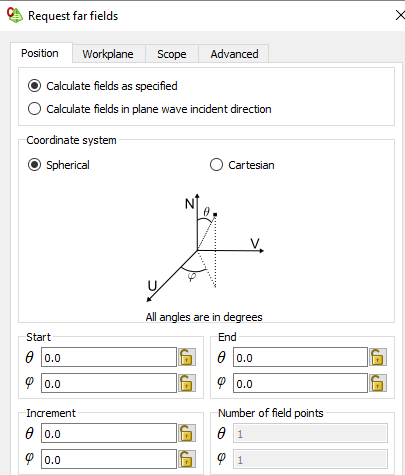
Not sure what you mean? The user must request the ranges of angles for the far field to calculate. This is on the Request far fields dialog.
Join us for a community conversation on how High-Performance Computing (HPC) and Simcenter PSIM work together to meet the increasing demands of modern power electronics simulation. During this one-hour technical session, you'll discover how leveraging HPC can speed up simulations, improve scalability, and empower engineers…
Join us for a community conversation on accelerating your motor simulation workflow with Simcenter Simlab. In this beginner-friendly session, we'll introduce the platform's automated model-building capabilities and show how easy it is to set up your first electric motor analysis. You'll see the basic steps of geometry…
Join us for a Community Conversation where we'll discuss practical approaches to analyzing complex electromagnetic models using hybrid solver techniques. This session will provide a general overview of how different computational methods can be combined within a single simulation to address models containing varied…