The Siemens Community Catalyst program was co-created with our community to acknowledge technology leaders who consistently contribute to the Siemens Community. Nominations are accepted on a rolling basis.
how can we calculating the capacitance and inductance matrices of multi-cable system in FEKO software ?
for example 8- parallel wires, bundles of twisted wires pairs, micro-strip line, printed circuit board PCB
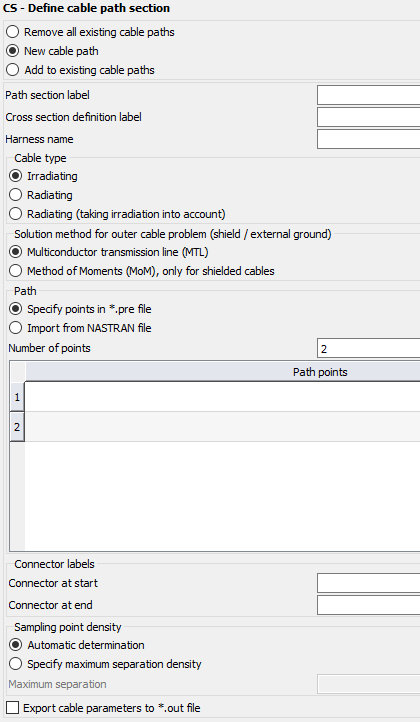
You can export these parameters to the *.out file.
Presently this option can only be enabled in EDITFEKO under the CS card.
Basically after setting the up your model and meshing it in CADFEKO, from there, run EDITFEKO. Find the CS card(s), click on them and hit F1 to edit, and check the box 'Export cable parameters to *.out file', save and run FEKO.
Hello,
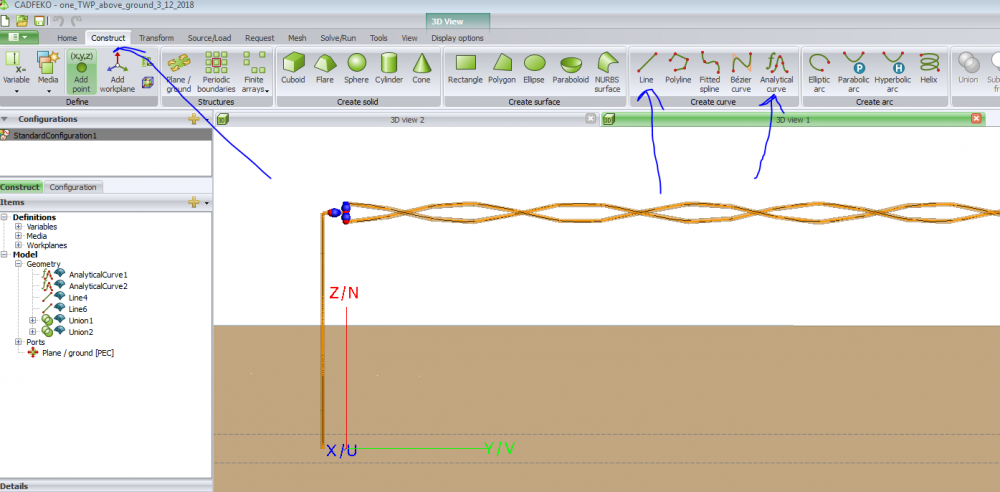
i would like to inform you that the cables had been build by using the construction button and '' Analytical curve'' as shown in the attached image. (not the cables button).
can you explain in details how can we obtain the capacitance matrix for multi-cable system (any specific wire path can plotted using analytical curve button ) with and without coating dielectric.
Sincerely,
<?xml version="1.0" encoding="UTF-8"?>
please, I m waiting for a reply
It is not possible without the cable modeller.
From your answer, I can understand that it is not possible to obtain the per-unit-length capacitance matrix of any arbitrary transmission line system ( non-uniform transmission line).
I hope that in the future edition you will improve FEKO so that it will have this feature.
thank you,
hello again
can you explain to us how can we obtain the per-unit-length capacitance of two parallel lines? each one has a coating. as you mentioned before, it is possible by using cable modeler, please explain to us all the steps in details
thank you in advance
See FEKO Example Guide example D-02 on how to use the cable modeller in CADFEKO.
After completing the model setup in CADFEKO, follow the steps I summarised in my post on 9th March to obtain the parameters.
Join us for a community conversation on how High-Performance Computing (HPC) and Simcenter PSIM work together to meet the increasing demands of modern power electronics simulation. During this one-hour technical session, you'll discover how leveraging HPC can speed up simulations, improve scalability, and empower engineers…
Join us for a community conversation on accelerating your motor simulation workflow with Simcenter Simlab. In this beginner-friendly session, we'll introduce the platform's automated model-building capabilities and show how easy it is to set up your first electric motor analysis. You'll see the basic steps of geometry…
Join us for a Community Conversation where we'll discuss practical approaches to analyzing complex electromagnetic models using hybrid solver techniques. This session will provide a general overview of how different computational methods can be combined within a single simulation to address models containing varied…