The Siemens Community Catalyst program was co-created with our community to acknowledge technology leaders who consistently contribute to the Siemens Community. Nominations are accepted on a rolling basis.
<?xml version="1.0" encoding="UTF-8"?>
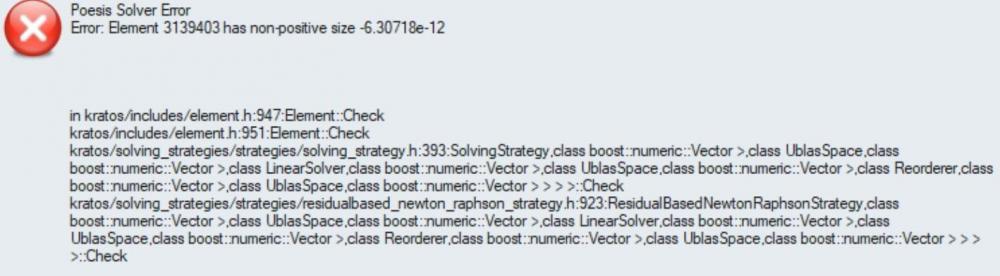
Solver fails in 2019.3
Please advise
Unable to find an attachment - read this blog
Hi Uri,
Thanks for showing us this , I have raised the ticket I will get back to you very soon.
Hello Sourav
Could you please check with the team?
As I need this simulation for the foundry.
Yes Uri,
My team is working on the issue I have informed them and ticket is raised for the following concern.
Already 8 days have passed...
I am still working with the team no response yet.
Already 15 days have passed...
I am sorry I understand the situation I shall raise this issue now to the director. Thanks for your patience.
Any news for the problem posted on October 14 ?
Yes , this is not a solver error. More information can be gathered from solver log (PoesisCasting.log) and error log (PoesisSolverError.log).
Error: Element 3127600 has non-positive size -6.30718e-12
Linear-Solver-Factory: Constructing a regular (non-complex) linear-solver
NodeToNodeMapperUtility: WARNING!! : Part and Mold meshes are NO-conforming, Advanced Mapper will be used
Seeting the time step limits for the thermal problem ***
** Estimated min_dt for thermal shocks is 2.318450e+00 ***
** Estimated Chorinov's solidification time is 3.057709e+00 ***
** min_dt automatically set to 3.057709e-02 ***
** max_dt automatically set to 5.000000e+01
There is a mesh issue, the element 3127600 is wrong (please see the very first lines of the error) in , it does not even have same number of faces between part and mold.
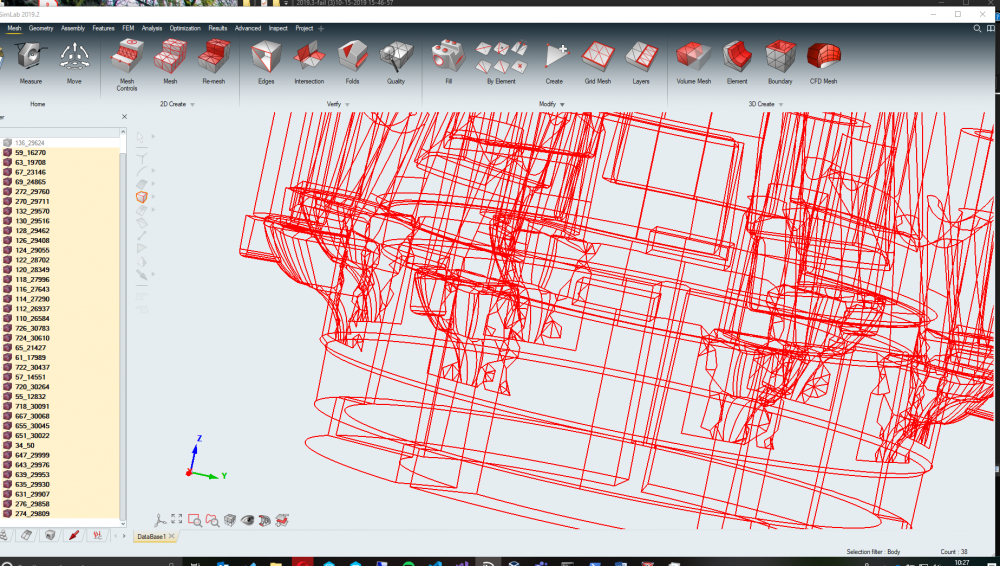
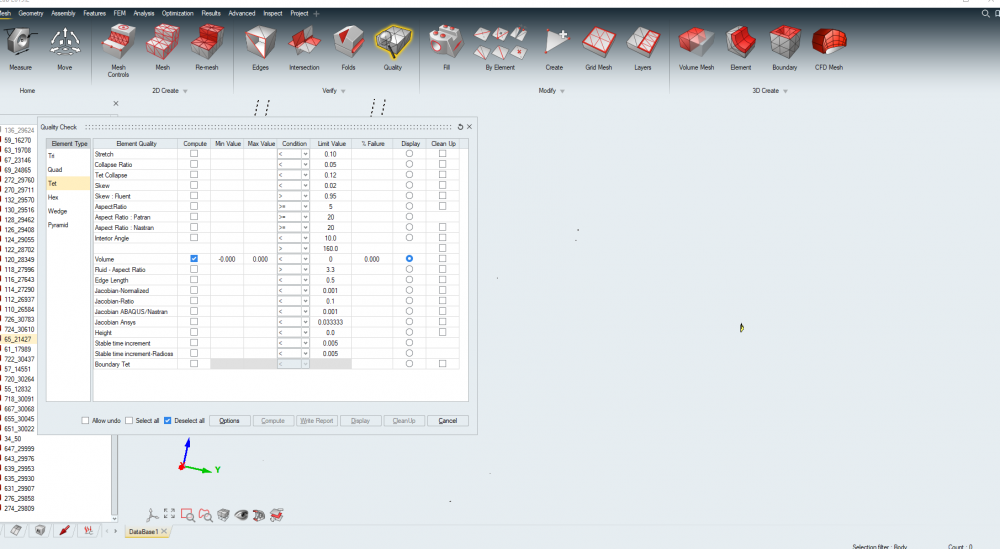
If you open the GDA in simlab you can check for quality and see exactly where it is failing.
We are still working on it, I shall keep update with you.
Thanks.
I am waiting...
Join us for a community conversation on how High-Performance Computing (HPC) and Simcenter PSIM work together to meet the increasing demands of modern power electronics simulation. During this one-hour technical session, you'll discover how leveraging HPC can speed up simulations, improve scalability, and empower engineers…
Join us for a community conversation on accelerating your motor simulation workflow with Simcenter Simlab. In this beginner-friendly session, we'll introduce the platform's automated model-building capabilities and show how easy it is to set up your first electric motor analysis. You'll see the basic steps of geometry…
Join us for a Community Conversation where we'll discuss practical approaches to analyzing complex electromagnetic models using hybrid solver techniques. This session will provide a general overview of how different computational methods can be combined within a single simulation to address models containing varied…