The Siemens Community Catalyst program was co-created with our community to acknowledge technology leaders who consistently contribute to the Siemens Community. Nominations are accepted on a rolling basis.
<?xml version="1.0" encoding="UTF-8"?>I
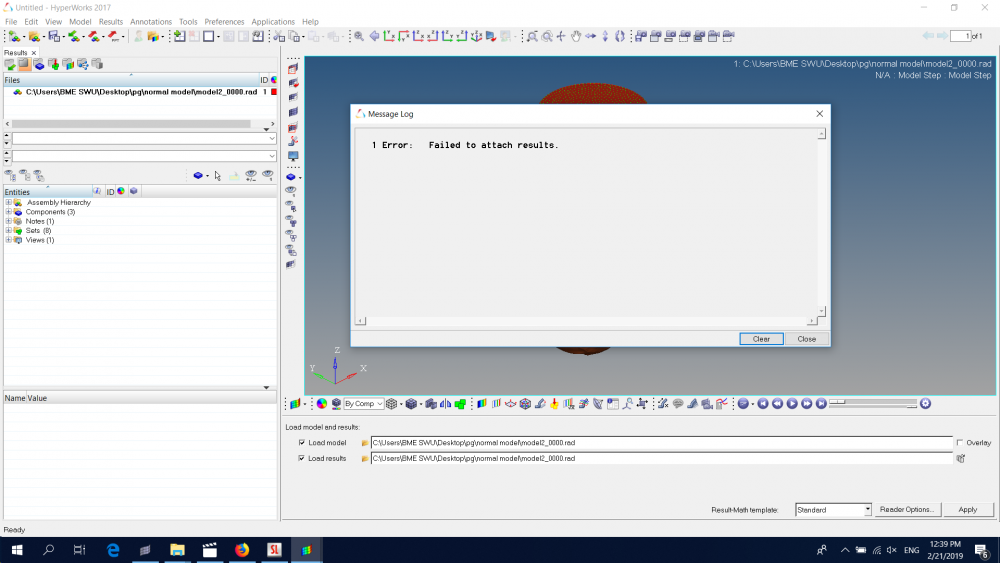
I found this problem many times. I am not sure that happen because of the boundary conditions or anything else.
And I imported model Optistruct file in Radioss solver, Is it ok or not?
Thank you for helping!
When you are loading the solver deck in hyperview, uncheck the load result.
.rad is a solver input which doesn't contain any results that is the reason you are getting that error.
When you are loading the solver deck in hyperview, uncheck the load result. .rad is a solver input which doesn't contain any results that is the reason you are getting that error.
Thank you for your reply.
Now, I am understand .rad is not a result file but after running analysis that have only both of .rad files, follow this picture.
That's mean the program doesn't run, right?
Yes, the program doesn't run ,
did u run analysis ?
Yes, the program doesn't run , did u run analysis ?
Yes, the program doesn't run ,
did u run analysis ?
Yes, I have run analysis already and I already use model checker, it doesn't has error anythings.
Is there any other problem in the program that is possible? @Pooja S
Best regards,
@Sukwasa
If the analysis ran without problems, the result should be available in the <modelname>.h3d file. We can also load the results WHILE simulation is running by opening <modelname>.A01 animation file.
<modelname>_000.rad is a starter file (containing loads, BCs, material, properties, mesh) and <modelname>_001.rad is an engine file (containing simulation controls).
Hi
Download the ebook from the below location and try the tutorial mentioned in the book or from Altair hyper works help for better understanding
https://altairuniversity.com/free-ebooks-2/free-ebook-crash-analysis-with-radioss-a-study-guide/
@Ivan @Pooja S Thank you very much for your reply!
Join us for a community conversation on how High-Performance Computing (HPC) and Simcenter PSIM work together to meet the increasing demands of modern power electronics simulation. During this one-hour technical session, you'll discover how leveraging HPC can speed up simulations, improve scalability, and empower engineers…
Join us for a community conversation on accelerating your motor simulation workflow with Simcenter Simlab. In this beginner-friendly session, we'll introduce the platform's automated model-building capabilities and show how easy it is to set up your first electric motor analysis. You'll see the basic steps of geometry…
Join us for a Community Conversation where we'll discuss practical approaches to analyzing complex electromagnetic models using hybrid solver techniques. This session will provide a general overview of how different computational methods can be combined within a single simulation to address models containing varied…
 I

