The Siemens Community Catalyst program was co-created with our community to acknowledge technology leaders who consistently contribute to the Siemens Community. Nominations are accepted on a rolling basis.
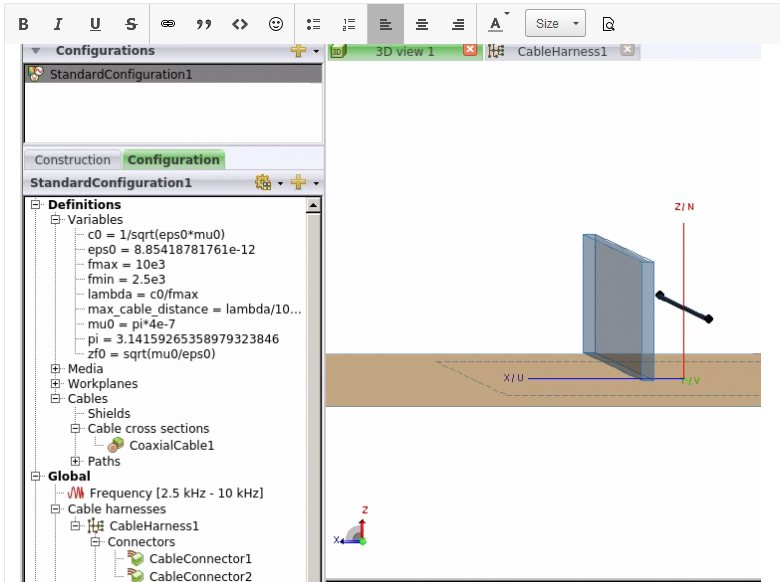
I got the warning 38142: Expecting a frequency in the specified range for the shield measurement data. Revert to using parameters at the lowest/highest frequency. In the .out file i find nothing like a hint or something else, which let me understand the problem ot the warning. I would like to ask what that should be or where the problem is?
Thanks in advance.
Hello /profile/99627-fudy/?do=hovercard' data-mentionid='99627' href='<___base_url___>/profile/99627-fudy/' rel=''>@fudy
Look for the warning in the .out file. Just above the warning, the frequency range for the selected predefined coaxial cable should be displayed. As I understand it, the warning tells you that the simulation frequency is outside the frequency range where the predefined coaxial cable is defined and the cable parameters as defined at the closest frequency to the simulation frequency is used.
Hello @MvdM
thanks for your answer. I see the details which you mean now. There is written: Cabletyp. RG58 C/U: 50 Ohm coax., single shield,diel. PE
1e+4 <= f <= 5E+8
f=2,5E+3
So i understand what you mean, because it is out of range with 2,5khz.
My idea was to measure the magnetic field of a standard coaxial cable (RG58) with a VOLTCRAFT GM-100 and then to compare it with a simulation in FEKO.
The measurement range of frequency of this product is 40hz untill 10khz.
What options do I have to realize something like this?
I would be happy about every suggestion.
Why not run the simulation at 10 kHz?
As the out file states, the frequency supported starts from 1e4 Hz (10 kHz), and your measurement device can measure up to 10 kHz.
I thank you for your answers, but I planned to simulate exactly the same frequency range to see the deviation and to refine the result in its settings. Now i will try other cables.
Join us for a community conversation on how High-Performance Computing (HPC) and Simcenter PSIM work together to meet the increasing demands of modern power electronics simulation. During this one-hour technical session, you'll discover how leveraging HPC can speed up simulations, improve scalability, and empower engineers…
Join us for a community conversation on accelerating your motor simulation workflow with Simcenter Simlab. In this beginner-friendly session, we'll introduce the platform's automated model-building capabilities and show how easy it is to set up your first electric motor analysis. You'll see the basic steps of geometry…
Join us for a Community Conversation where we'll discuss practical approaches to analyzing complex electromagnetic models using hybrid solver techniques. This session will provide a general overview of how different computational methods can be combined within a single simulation to address models containing varied…