The Siemens Community Catalyst program was co-created with our community to acknowledge technology leaders who consistently contribute to the Siemens Community. Nominations are accepted on a rolling basis.
Hi all,
I'm learning how to convert from time domain to frequency domain using Altair Compose, I see some variables that I don't really understand:
Can anyone explain for me?
Thanks.
Hello Nancy,
the variables that you see over here are:Fs: sampling frequency which defines the number of samples per second taken from a continuous signal to make a discrete or digital signal.L: length of signal which defines the total number of measured points
T: sampling period which defines the time difference between two consecutive samples (here it's used just to help construct the time vector below).t: time vector contains from beginning to end its time instant that a measurement on the signal was made.I am attaching here some more information
1) FFT in-build function documentation: https://help.altair.com/compose/help/en_us/topics/reference/oml_language/SignalProcessing/fft.htm?hl=fft
2) Signal Processing video series - FFT:https://www.youtube.com/watch?v=HV7WqrZppygHope this helps!Best regards,Orestes.
Hi Nancy,
Adding to what Orestes said, you might find it useful to look at our signal processing eLearning:
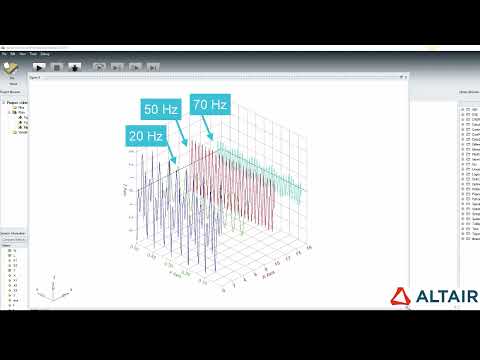
Altair Compose - Signal Processing
Rafael
Join us for a community conversation on how High-Performance Computing (HPC) and Simcenter PSIM work together to meet the increasing demands of modern power electronics simulation. During this one-hour technical session, you'll discover how leveraging HPC can speed up simulations, improve scalability, and empower engineers…
Join us for a community conversation on accelerating your motor simulation workflow with Simcenter Simlab. In this beginner-friendly session, we'll introduce the platform's automated model-building capabilities and show how easy it is to set up your first electric motor analysis. You'll see the basic steps of geometry…
Join us for a Community Conversation where we'll discuss practical approaches to analyzing complex electromagnetic models using hybrid solver techniques. This session will provide a general overview of how different computational methods can be combined within a single simulation to address models containing varied…