The Siemens Community Catalyst program was co-created with our community to acknowledge technology leaders who consistently contribute to the Siemens Community. Nominations are accepted on a rolling basis.
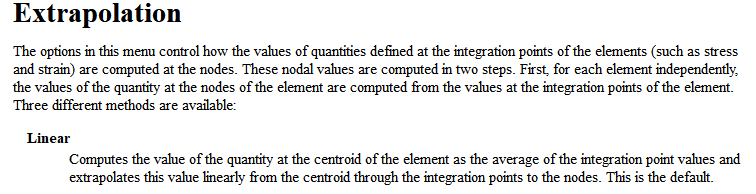
sometimes we can not read Marc Mentat t16 result file; we can not get the same stress/strain between HV and Mentat; without Linear Extrapolation in HV, but linear extrapolation is default for Mentat.
Hi,
Please let us know the version.
HyperView supports MARC t16 files for version 2008 r1.
Hi, Please let us know the version. HyperView supports MARC t16 files for version 2008 r1.
I use Marc Mentat 2014, the lastest version. but I think Version is not problem.
The h3d file by HvTrans will give different stress results back compared to Mentat Results if you read it in directly -due to Different node averaging, the same problem in HV. But I need to convert the t16 file into same results for H3d compared to Mentat.
Another issue is that HV can not read all element types from T16 and prints out error message.
I know that somebody build a h3d converter for t16, based on HvTrans. I hope it can be shared.
Hi all,
Are there any news about this topic? I've been using Marc Mentat 2021 but the same issue cropped up. In detail, i'm using hyperview and the problem is with linear extrapolation as abovementioned ( default for Marc Mentat). Method translate showed same results but there is an underestimation of stress value. Has Anyone figured out a solution?
Hello,
I am also interested in a solution to this issue. I have the same problem. The stress/strain values do not correspond to the maximum displayed in Mentat. Is there perhaps a script for this, or can someone help write such a script? In Mentat the stress values are extrapolated linearly.
You may need to adjust the Nodal averaging to get the same results as other Post Processors that may do this by default. By default Hyperview displays the results from the solver which tend to be at the element centroid.
https://help.altair.com/hwdesktop/hwx/topics/panels/nodal_averaging_elemental_results_hv_r.htm?zoom_highlight=nodal+averaging
Join us for a community conversation on how High-Performance Computing (HPC) and Simcenter PSIM work together to meet the increasing demands of modern power electronics simulation. During this one-hour technical session, you'll discover how leveraging HPC can speed up simulations, improve scalability, and empower engineers…
Join us for a community conversation on accelerating your motor simulation workflow with Simcenter Simlab. In this beginner-friendly session, we'll introduce the platform's automated model-building capabilities and show how easy it is to set up your first electric motor analysis. You'll see the basic steps of geometry…
Join us for a Community Conversation where we'll discuss practical approaches to analyzing complex electromagnetic models using hybrid solver techniques. This session will provide a general overview of how different computational methods can be combined within a single simulation to address models containing varied…