The Siemens Community Catalyst program was co-created with our community to acknowledge technology leaders who consistently contribute to the Siemens Community. Nominations are accepted on a rolling basis.
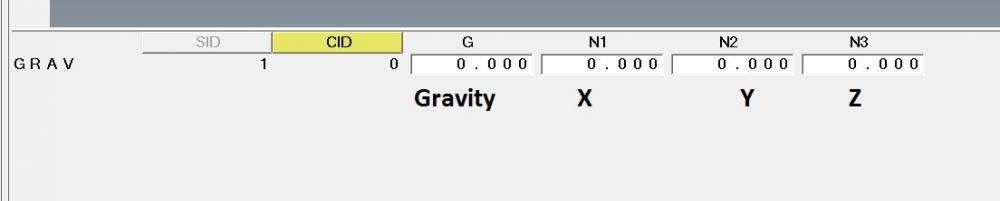
I m having problem to understand GRAV card image of load collector.
please help
Hi,
Please check the image below (Global coordinate system)
<?xml version="1.0" encoding="UTF-8"?>
How does a computer can know to which component in an assembly acceleration needs to be applied.
As we don't give any input to GRAV of component or assembly
iashishsarode
Gravity is applied as a field on the entire model.
thank you for helping me to understand.
My plan is to apply the gravity on the y-z plane in the direction of the bisector formed by the y and z Vector.
How would i do that?
By having the input:
g: 5 units
n1: 0
n2: 1
n3: 1
Would that mean the value 5 units would be applied simultaneously in the y-direction as well as in the z-direction or would it mean that 5 units would be applied in the direction of the bisector of z and y?
My plan is to apply the gravity on the y-z plane in the direction of the bisector formed by the y and z Vector. How would i do that? By having the input: g: 5 units n1: 0 n2: 1 n3: 1 Would that mean the value 5 units would be applied simultaneously in the y-direction as well as in the z-direction or would it mean that 5 units would be applied in the direction of the bisector of z and y?
G is the total magnitude and N1, N2 and N3 will give you the direction only.
If you want to compute individually, you can create multiple GRAV cards and combine them with LOADADD card.
I.e: create 2GX, create 1GZ and then combine them with LOADADD card.
Or also create unit GRAV in each direction, and use the S1 multipliers to get the 2G, 1G, etc..
Join us for a community conversation on how High-Performance Computing (HPC) and Simcenter PSIM work together to meet the increasing demands of modern power electronics simulation. During this one-hour technical session, you'll discover how leveraging HPC can speed up simulations, improve scalability, and empower engineers…
Join us for a community conversation on accelerating your motor simulation workflow with Simcenter Simlab. In this beginner-friendly session, we'll introduce the platform's automated model-building capabilities and show how easy it is to set up your first electric motor analysis. You'll see the basic steps of geometry…
Join us for a Community Conversation where we'll discuss practical approaches to analyzing complex electromagnetic models using hybrid solver techniques. This session will provide a general overview of how different computational methods can be combined within a single simulation to address models containing varied…