The Siemens Community Catalyst program was co-created with our community to acknowledge technology leaders who consistently contribute to the Siemens Community. Nominations are accepted on a rolling basis.
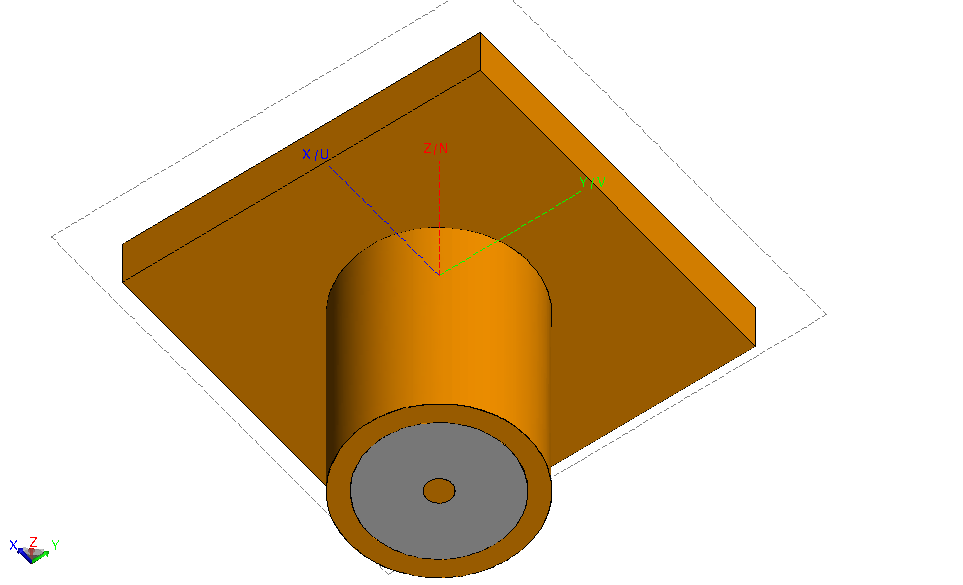
I use Feko version 14.0.432 and try to design SMA connector. But I don't know how to add source port. Please advise.
<?xml version="1.0" encoding="UTF-8"?>
Hello bm kung
It looks like you are almost there. If the model uses MoM (the default) with SEP for the dielectric (default), then you need to add waveguide ports. You would add a waveguide port on the dielectric face on both sides. If you then want to calculate the reflection coefficient, add a waveguide source on one of the ports (the other port will then only have a port on it and act as a sink / load). If you want to perform an S-parameter calculation, then you would not add the source, but rather add an S-parameter request for the ports.
If you are using FEM (instead of MoM), then you need to add FEM Modal ports instead of waveguide ports. You will also add a FEM Modal source instead of a waveguide source.
A good example to look at that shows both the MoM and FEM models is Example 'A-12 Dielectric resonator antenna on finite ground' in the Example Guide.
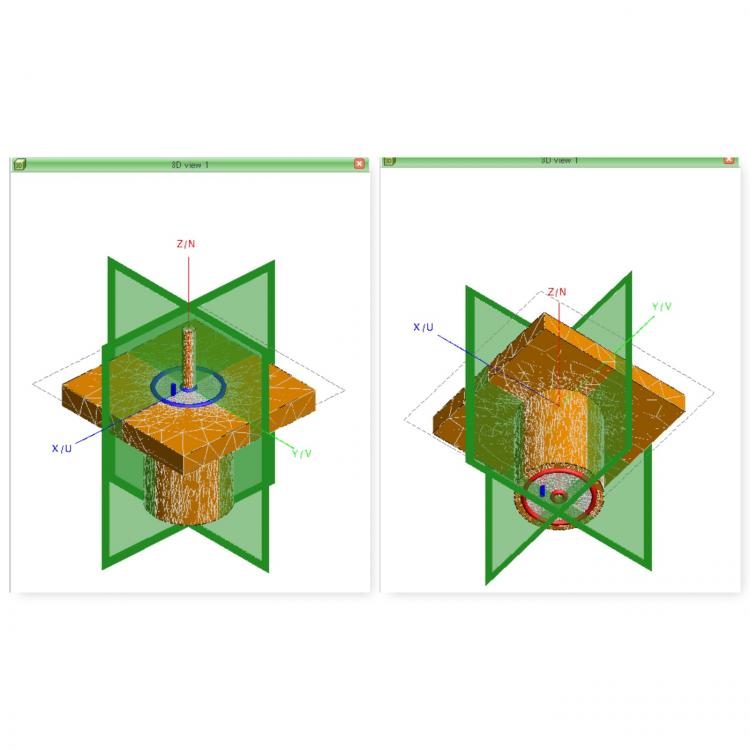
Thank you for your reply. I will follow your suggestion. I had been attached the picture to show waveguide ports configuration. It's correct or not ?
I only noticed that I had a follow-up question now. Sorry about that. The source port in your example (right) is correct. Your sink port (load, left) is not correct. if you want to just model the transitions inside the SMA, then remove the extruding pin. If you want to model the SMA connector with the pin not connected to anything, then remove the second port (sink). If you want to connect the SMA to some other device, remove the sink port and model the transition and the rest of your model.
Without more context, it is difficult to provide more precise answers.
Join us for a community conversation on how High-Performance Computing (HPC) and Simcenter PSIM work together to meet the increasing demands of modern power electronics simulation. During this one-hour technical session, you'll discover how leveraging HPC can speed up simulations, improve scalability, and empower engineers…
Join us for a community conversation on accelerating your motor simulation workflow with Simcenter Simlab. In this beginner-friendly session, we'll introduce the platform's automated model-building capabilities and show how easy it is to set up your first electric motor analysis. You'll see the basic steps of geometry…
Join us for a Community Conversation where we'll discuss practical approaches to analyzing complex electromagnetic models using hybrid solver techniques. This session will provide a general overview of how different computational methods can be combined within a single simulation to address models containing varied…