The Siemens Community Catalyst program was co-created with our community to acknowledge technology leaders who consistently contribute to the Siemens Community. Nominations are accepted on a rolling basis.
Deal All,
In our board we use Delfino 28335. For ADC we use 2.048V external ADC.
In solidThinking Embedded is it possible to select external reference for ADC?
Hi,
Here's a link to the TMS320x2833x Analog-to-Digital Converter Module Technical Reference.
http://www.ti.com/lit/ug/spru812a/spru812a.pdf
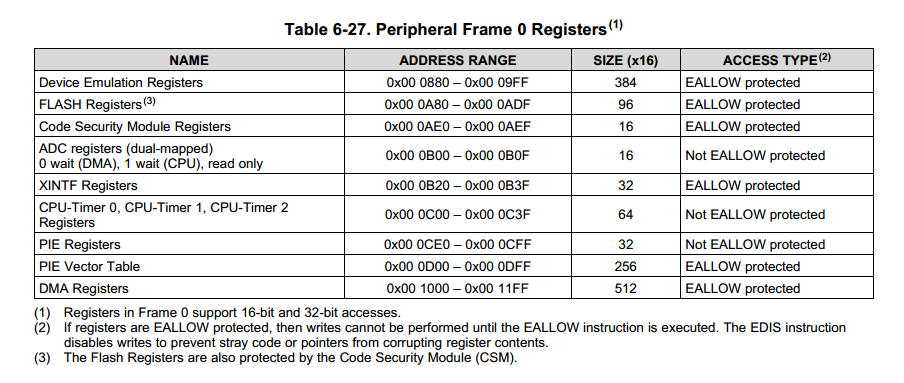
Page 43 describes the ADC Reference Select Register. You should be able to create an external write to this register from within your diagram to set bits 15-14 to 01, selecting an external 2.048V reference.
Use the embedded block Extern Definitions as shown in the attached diagram to write to the ADC reference selection register as shown within the Initialize block. It looks like the base address for the ADC is 0x0B00, but you should verify this yourself and change ADC_BASE to the correct ADC base address the ADC_REF_REGISTER definition block.
Define your own ADC_REF_REGISTER:
#define ADC_REF_REGISTER *((volatile unsigned short *)(ADC_BASE+0x1C))
Since bits 13-0 must be preserved, we read-modify-write the value of the register to clear bits 15-14 without changing bits 13-0.
ADC_REF_REGISTER &= 0x3FFF
Then we set the new value (01) of bits 15-14, selecting the external 2.048V reference, into the register with another read-modify-write.
ADC_REF_REGISTER |= 0x4000
After you Tools->Code Gen, it's often interesting to view the generated C code. You should be able to find the C statements generated from the External Definition blocks described above.
The blocks included in the attached diagram must be copied into your existing F28335 diagram which has a Embedded->Delfino->F28x Config Block.
Tom
Corrected attached diagram
<?xml version="1.0" encoding="UTF-8"?>
Unable to find an attachment - read this blog
Join us for a community conversation on how High-Performance Computing (HPC) and Simcenter PSIM work together to meet the increasing demands of modern power electronics simulation. During this one-hour technical session, you'll discover how leveraging HPC can speed up simulations, improve scalability, and empower engineers…
Join us for a community conversation on accelerating your motor simulation workflow with Simcenter Simlab. In this beginner-friendly session, we'll introduce the platform's automated model-building capabilities and show how easy it is to set up your first electric motor analysis. You'll see the basic steps of geometry…
Join us for a Community Conversation where we'll discuss practical approaches to analyzing complex electromagnetic models using hybrid solver techniques. This session will provide a general overview of how different computational methods can be combined within a single simulation to address models containing varied…