The Siemens Community Catalyst program was co-created with our community to acknowledge technology leaders who consistently contribute to the Siemens Community. Nominations are accepted on a rolling basis.
Submitted by pete on Wed, 05/13/2009 - 22:25
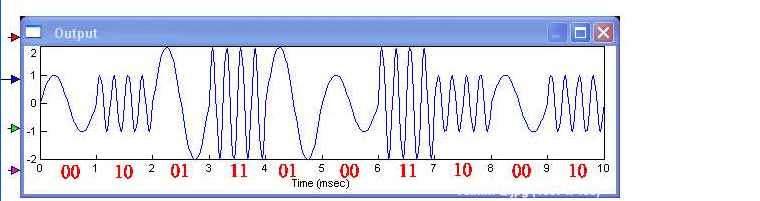
I need to produce these waveforms
Submitted by pete on Wed, 05/13/2009 - 22:27.
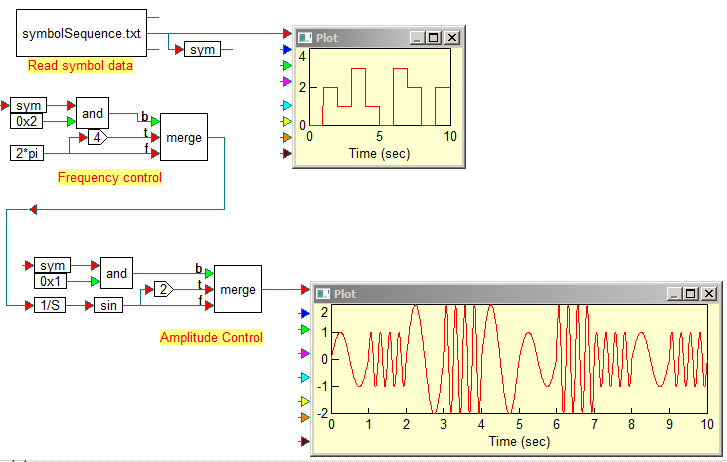
1) Use Import block to read data file containing symbols valued 1 thru 3. Set data point interval to 1 sec and disable interpolation.2) Merge blocks selects frequency and amplitude gains based on testing bits in input symbol stream from import block.3) Boolean AND of input data with 0x1 tests low order bit 1 (True for binary 01 and 11, decimal 1 and 3), Boolean AND of 0x2 tests bit 2 (binary 10 and 11, decimal 2 and 3)4) Frequency is controlled by using merge block to apply gain of 4 to 2pi based on symbol bit test from 3). 1/s integrates frequency constant to create ramp of input slope to sin.5) Amplitude is controlled by using merge block to apply gain of 2 to sin output.
Unable to find an attachment - read this blog
Submitted by samuel on Fri, 07/23/2010 - 02:33.
I do not understand what is going on with the 'AND' portion of the block diagram. I thought AND had to take Boolean inputs, but the values from symbolSequence.txt are decimal. And what are the '0x2' and '0x1' constants? Are they in hex format?
I can't find the answers to these questions within the VisSim User's Guide or with in the program's help menu.
Thanks.
Submitted by pete on Fri, 07/23/2010 - 10:20.
However, 0x1 = 1 and 0x2 = 2 so you don't need to use hex in this situation. The 'and' operator is doing a bitwise and. In this case, each bit in one binary word is 'and'ed with the corresponding bit in the other word. We are using 2 bits in this case.
Submitted by samuel on Fri, 07/23/2010 - 23:55.
I appreciate the response.
Join us for a community conversation on how High-Performance Computing (HPC) and Simcenter PSIM work together to meet the increasing demands of modern power electronics simulation. During this one-hour technical session, you'll discover how leveraging HPC can speed up simulations, improve scalability, and empower engineers…
Join us for a community conversation on accelerating your motor simulation workflow with Simcenter Simlab. In this beginner-friendly session, we'll introduce the platform's automated model-building capabilities and show how easy it is to set up your first electric motor analysis. You'll see the basic steps of geometry…
Join us for a Community Conversation where we'll discuss practical approaches to analyzing complex electromagnetic models using hybrid solver techniques. This session will provide a general overview of how different computational methods can be combined within a single simulation to address models containing varied…