The Siemens Community Catalyst program was co-created with our community to acknowledge technology leaders who consistently contribute to the Siemens Community. Nominations are accepted on a rolling basis.
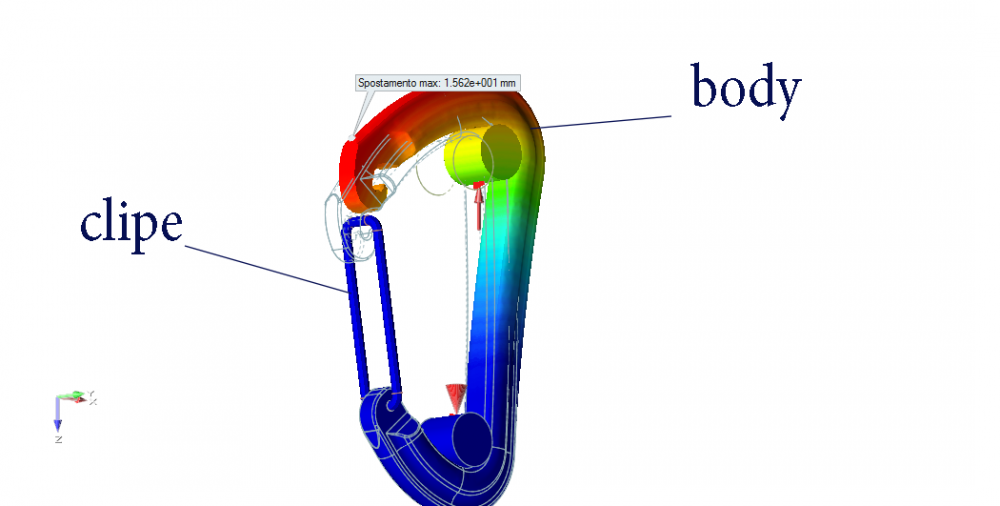
As you can see in the figure, during the FEA, the top of the body should touch the clip at the high deformation, but it doesn't.
Why is there not contact between different parts?
<?xml version="1.0" encoding="UTF-8"?>
Hi Marco,
there should be contact defined between the clip and the body.
Please refer to:
https://solidthinking.com/training/2015/inspire/content/opti_setup/contacts.htm
https://www.google.com/search?q=Altair+inspire++contact&client=firefox-b&source=lnms&tbm=vid&sa=X&ved=0ahUKEwjBh_6u2oDeAhVDEiwKHWFIBA4Q_AUIDygC&biw=1920&bih=951
Hi Ivan,
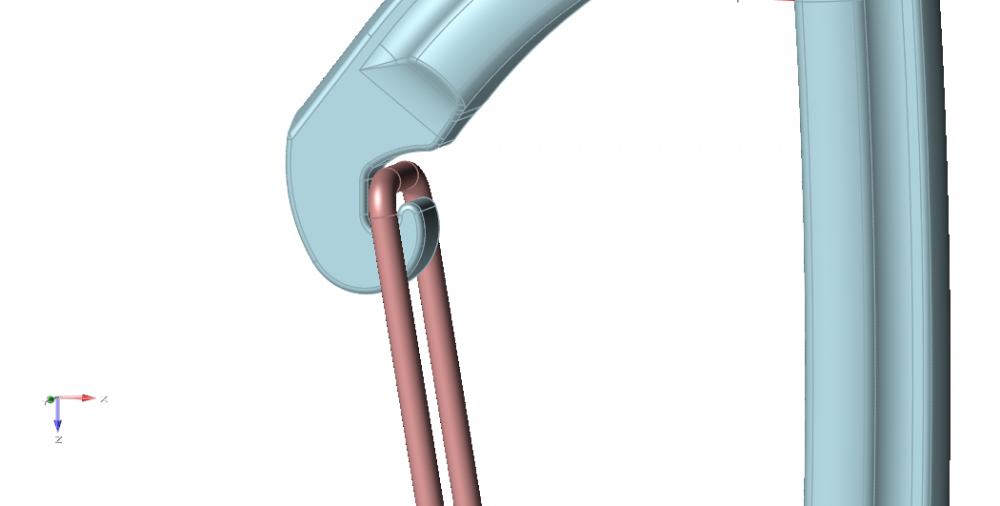
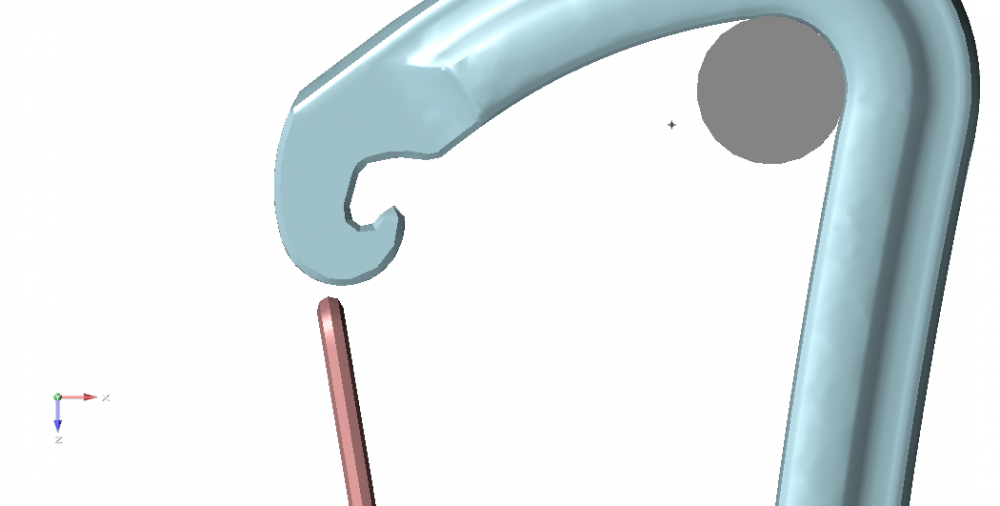
thanks for your answer but the real problem is that there is a little gap between clip and body in resting position. Then, applying the load, the body crosses the clip without contact.
It has been a while since I last used the Inspire, so I am not up to date on its functionality.
There was Clearance Parameter for Contacts introduced in 2018.1 version, which allows you to define when a contact is considered in cases where there is a slight separation between parts in contact.
Also check contact validity.
If the initial gap is too big it is a contact non-linearity, but the Inspire is based on linear solver, so it might not be suitable for such problems.
Thanks Ivan. Yes, the problem is actually non linear. I have to try with another software.
You can try with Optistruct- just import the .fem file and run either NLSTAT, NLGEOM, EXPDYN or IMPLDYN analysis.
Perfect, thanks.
Join us for a Community Conversation where we'll discuss practical approaches to analyzing complex electromagnetic models using hybrid solver techniques. This session will provide a general overview of how different computational methods can be combined within a single simulation to address models containing varied…
Join us for a community conversation to explore how different modeling approaches in Simcenter PSIM can help engineers simulate power electronics systems while balancing accuracy, simulation speed, and design insight. What you'll learn: Power transistor modeling : Thermal and high fidelity models Protection component…