The Siemens Community Catalyst program was co-created with our community to acknowledge technology leaders who consistently contribute to the Siemens Community. Nominations are accepted on a rolling basis.
Dear Altair Team,
I have constrained the rectangular beam in one end (all dof fixed) and applied Angular displacement in other end (120deg angular displacement applied along axis of rod using spcd). Could you please explain how to extract the torque or moment produced at fixed end due to angular displacement. Also explain how to create the graph between the torque vs applied angular displacement.
Thank you.
Unable to find an attachment - read this blog
Hi,
you have to request the SPC reaction forces:
ANALYSIS->CONTROL CARDS->GLOBAL_OUTPUT_REQUEST
SPCFORCE(H3D,ALL) = ALL
Later on, you can show the forces in Hyperview as contour plot (SPCF forces) or (better) as vector plot.
Then you can plot torque vs applied angular displacement using cross-plot
Hi, you have to request the SPC reaction forces: ANALYSIS->CONTROL CARDS->GLOBAL_OUTPUT_REQUEST SPCFORCE(H3D,ALL) = ALL Later on, you can show the forces in Hyperview as contour plot (SPCF forces) or (better) as vector plot. Then you can plot torque vs applied angular displacement using cross-plot https://community.altair.com/community?id=community_question&sys_id=c586c83a1b2bd0908017dc61ec4bcb4e
Here I have to extract reaction torque or reaction moment and not the reaction forces.
How to take the reaction moment at fixed end and please explain with fem file.
I have found the following issues in the model you shared:
1. The SPCD units for rotational degrees-of-freedom is radians, so instead of 120, it should be 2.0944 radians to get 120 degrees rotation.
2. The model undergoes large rotations so large displacement analysis should be activated (PARAM/LGDISP=1 and PARAM/HASHASSM)
3. Convergence control was activated through the nonlinear expert system PARAM/EXPERTNL/YES
4. CNTSTB is redundant since there is no contact
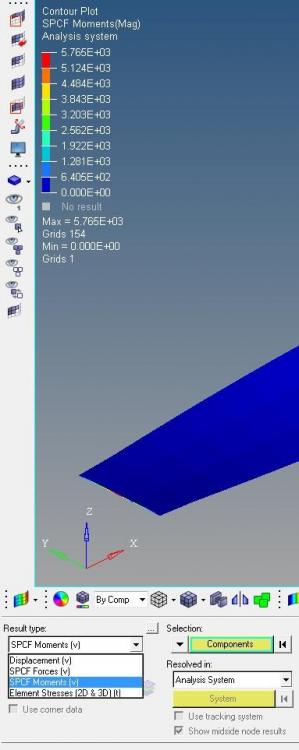
5. ANALYSIS->CONTROL CARDS->GLOBAL_OUTPUT_REQUEST> SPCFORCE(H3D,ALL) = ALL was defined to output SPC forces AND moments (see image)
<?xml version="1.0" encoding="UTF-8"?>
I have found the following issues in the model you shared: 1. The SPCD units for rotational degrees-of-freedom is radians, so instead of 120, it should be 2.0944 radians to get 120 degrees rotation. 2. The model undergoes large rotations so large displacement analysis should be activated (PARAM/LGDISP=1 and PARAM/HASHASSM) 3. Convergence control was activated through the nonlinear expert system PARAM/EXPERTNL/YES 4. CNTSTB is redundant since there is no contact 5. ANALYSIS->CONTROL CARDS->GLOBAL_OUTPUT_REQUEST> SPCFORCE(H3D,ALL) = ALL was defined to output SPC forces AND moments (see image) <?xml version="1.0" encoding="UTF-8"?>
Hi Ivan,
Thanks for your suggestions.
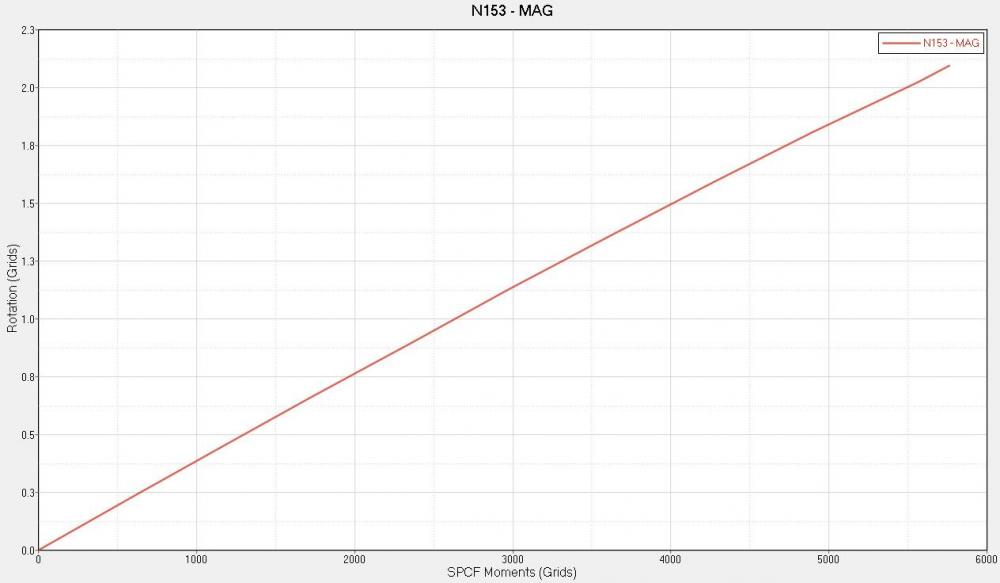
Could you please explain me how to create the graph for moment vs angle for this job.
You have to request the rotations with analysis>control cards> GLOBAL_OUTPUT_REQUEST > DISPLACEMENT>ROTATIONS>ROTA
in Hypergraph plot the moment and rotations (mind the node IDs, in your case 153 &154) and then use the cross-plot mentioned before or directly set the appropriate X & Y type requests to plot in one go.
Join us for a community conversation on how High-Performance Computing (HPC) and Simcenter PSIM work together to meet the increasing demands of modern power electronics simulation. During this one-hour technical session, you'll discover how leveraging HPC can speed up simulations, improve scalability, and empower engineers…
Join us for a community conversation on accelerating your motor simulation workflow with Simcenter Simlab. In this beginner-friendly session, we'll introduce the platform's automated model-building capabilities and show how easy it is to set up your first electric motor analysis. You'll see the basic steps of geometry…
Join us for a Community Conversation where we'll discuss practical approaches to analyzing complex electromagnetic models using hybrid solver techniques. This session will provide a general overview of how different computational methods can be combined within a single simulation to address models containing varied…